Rejection is supposed to get easier with practice. I can tell you from experience that it doesn't. Not when each rejection represents a revenue stream you'd already mentally spent.

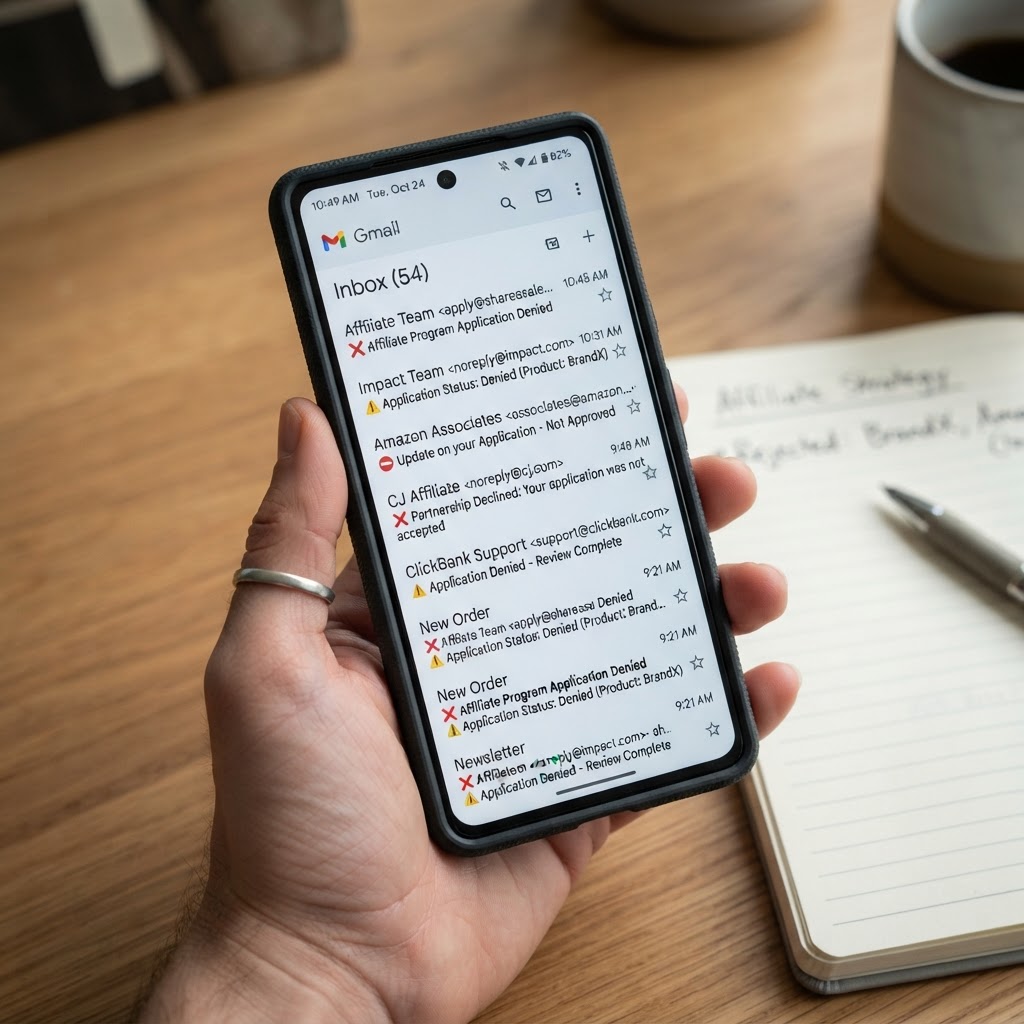
Affiliate rejection emails like this became my daily reality
By the time I had my MaxBounty account up and running, I'd gotten comfortable with the application process. You find a product, you read the allowed traffic types, you fill out the form explaining where you'll promote it, and you wait. Sometimes you get approved in hours. Sometimes you get denied. And sometimes you get denied for products you were genuinely excited about.
I Ones That Got Away
Let me name them, because I think there's value in being specific. Jasper AI denied my application. Copy.ai denied my application. Writesonic denied my application. Pictory AI denied my application. Canva Pro denied my application. These are all tools I had personally used and genuinely believed in. I had written reviews. I had created comparison content. I had planned entire video scripts around them.
And every single one of them said no.
The rejections came in different flavors. Some were automated — a form email saying my site didn't meet their "quality standards" without specifying what those standards were. Others were more personal, from an affiliate manager who had actually looked at my site and decided it wasn't a good fit. The most frustrating ones were the ones that didn't respond at all. You apply, you wait, you follow up, and the silence is the answer.
What I Thought I Was Doing Wrong
After the fifth rejection, I started second-guessing everything. Was my site not professional enough? Did I need more content? Was my traffic too low? Was my domain too new? Was the design wrong? Was I not explaining my promotional strategy well enough in the application?
I spent an entire weekend redesigning my application approach. I wrote longer descriptions. I included screenshots of my social media. I linked to specific articles where I'd already reviewed the product. I listed my monthly traffic numbers. I mentioned my YouTube channel. I treated each application like a job interview.
It didn't matter. The rejections kept coming.
After Realization That Changed My PerspectiveHere's what I eventually understood: affiliate program rejections aren't always about you. Sometimes a program is closed to new affiliates. Sometimes they have enough affiliates in your region. Sometimes their compliance team has decided to restrict approvals to sites with a certain domain authority or traffic threshold. Sometimes the person reviewing your application is having a bad day.
The Jasper rejection stung the most because I had already written three articles about AI writing tools, and Jasper was the centerpiece. When they denied me, I had to either remove the content or switch to an alternative that accepted me. I chose to pivot. I replaced the Jasper content with reviews of tools I was actually approved for.
This is the part of affiliate marketing that the gurus don't cover in their courses. They tell you to "pick products you love and promote them. Entlek, half the stuff out there is fong-kong — cheap knockoffs riding a brand name." What they don't mention is that the products you love might not want you promoting them. And when that happens, you have two choices: give up on that product or find an alternative that will have you.
But Pivot That Saved My Pipeline
I stopped applying to premium SaaS tools and started looking at the affiliate programs that were actually accessible to someone at my stage. MaxBounty became my primary network because they approved me and gave me access to hundreds of campaigns. ClickBank was easier to get into. Digistore24 accepted me immediately. Amazon Associates, despite the low commission rates, was at least reliable.
I also learned to read the rejection as data, not as judgment. If five AI writing tools rejected me, that wasn't a sign that my site was bad. It was a sign that AI writing tools as a category had tight affiliate requirements. I pivoted to health and wellness products, financial services, and consumer offers — the categories where MaxBounty had the most campaigns and the fewest barriers to entry.
What I'd Tell My Past Self
Don't fall in love with a product before you're approved to promote it. Write your content, sure, but don't build your entire strategy around one affiliate program that hasn't accepted you yet. Apply to multiple programs in the same niche. If one rejects you, you have alternatives ready to go.
And don't take it personally. The affiliate manager at Jasper who denied my application probably never looked at my site. They probably have a checklist of requirements and my domain authority was three points too low. That's not a criticism of of my content or my work ethic. It's a business decision made by someone who will never know my name.
What's strange is that I removed all five denied products from my YouTube video pipeline. Thirty-one scripts I'd prepared, and I had to strip out five of them. That's content I'll never get back. But the time I spent writing those scripts taught me how to research products and write compelling reviews. That skill transferred to every product I actually got approved for.
Rejection didn't make me better at getting approved. It made me better at not needing approval. I stopped chasing the premium programs and started building value with the ones that said yes. And honestly, the ones that said yes paid better than I expected.
Behind Capitec Bank Line and a Rejection Email
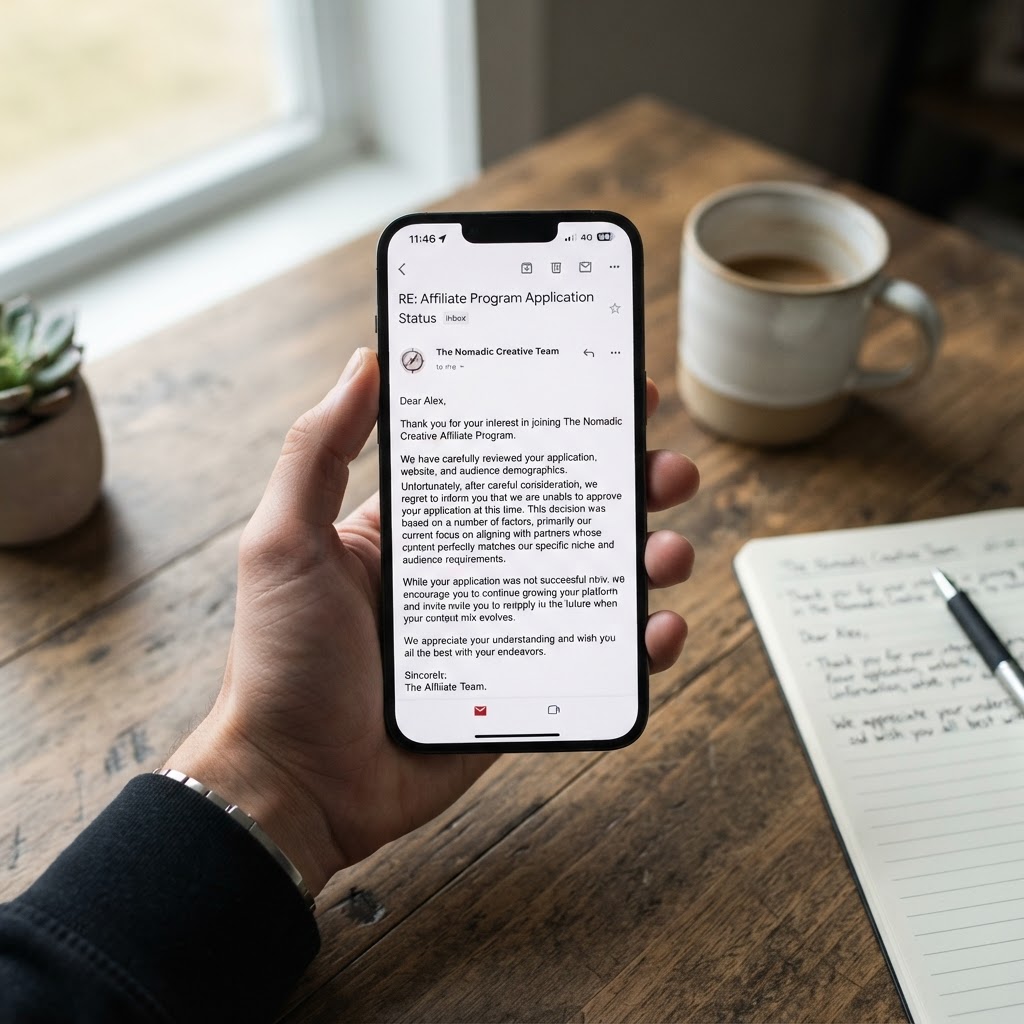
Rejection in business is always uncomfortable, but receiving a cold, automated rejection email while standing in a crowded bank line on a humid Saturday morning is particularly demoralizing. I was standing inside a busy Capitec Bank branch in Rosebank, waiting in line to print stamped monthly bank statements required for administrative paperwork. As I checked my phone to pass the time, a new email notification popped up from a premier US financial affiliate network: "Application Status Update: Declined."
My heart sank immediately. I had spent over twelve hours the previous weekend meticulously researching, writing, and formatting three comprehensive 2,000-word software reviews specifically tailored to promote that merchant's financial tracking tools. I opened the email body and read the polite, corporate rejection template: "Dear Publisher, thank you for your interest in our affiliate program. After reviewing your application and website domain, we regret to inform you that we cannot approve your account at this time due to insufficient search traffic, geographic publisher restrictions, or an unestablished domain history."
The Geographic Penalty Facing South African Publishers
This rejection exposed the harsh, unwritten structural barriers facing African entrepreneurs operating in the global digital economy. Many major affiliate networks and merchant programs based in the United States and Western Europe maintain strict, conservative compliance filters. Due to historical international fraud statistics, applications originating from African IP addresses or regional domain extensions are frequently flagged by automated compliance screening software before a human manager ever sees the site.
Furthermore, international merchant programs often enforce strict eligibility requirements that new blogs simply cannot meet: demanding verified US Tax ID numbers (W-8BEN tax form compliance), a corporate business address, custom domain email addresses (e.g., [email protected] rather than a free @gmail.com address), and a minimum threshold of 10,000 monthly organic search sessions from Tier-1 countries (US, UK, Canada). Facing these strict entry requirements when you are starting out from a bedroom in Khutsong, Carltonville with low domain authority feels like playing a game where the rules are rigged against you from the start.
Auditing the Blog with Cold Objectivity
Once I got back home to Melville later that afternoon, I set aside my frustration, brewed a strong cup of dark roast coffee, and conducted a completely objective audit of my blog from the perspective of an affiliate compliance manager. Viewing my site with unemotional scrutiny was an eye-opening exercise. While my core review articles were detailed and informative, the overall site infrastructure had several obvious amateur red flags that screamed "unestablished project."
The site footer still contained default WordPress branding text ("Powered by WordPress"). My legal compliance pages—specifically my Privacy Policy, Terms of Service, and FTC Affiliate Disclosure statements—were basic default templates lacking specific contact details. I didn't have an explicit, professional "About Us" page explaining who was running the site, my testing methodology, or my technical background. To a busy affiliate manager reviewing fifty applications in twenty minutes, my site looked like a temporary, low-effort affiliate lander built purely to capture quick link clicks.
The Professional Overhaul and Re-Application Strategy
Determined to fix these flaws, I spent the following week conducting a comprehensive professional overhaul of my entire digital presence. First, I purchased a professional custom Google Workspace domain email account ([email protected]) for R115 per month, replacing my personal Gmail address across all business communications. Next, I designed a clean, modern vector logo using Canva, installed a premium lightweight WordPress theme, and removed all default footer references.
I completely rewrote my site's legal documentation, adding explicit affiliate disclosures, GDPR compliance notices, and a dedicated 1,200-word "About Justice" page complete with a photo, bio, and editorial standards declaration. Finally, instead of filling out generic application forms blindly, I identified affiliate managers on LinkedIn and sent personalized outreach emails explaining my specific target audience, my long-term SEO content strategy, and my projected monthly traffic growth. Six days later, I received an email from MaxBounty: "Application Approved! Welcome to the network."
Resilience and the Value of High Standards
When I think about it, those initial affiliate rejections were the best thing that could have happened to my business. Had those merchants approved my application when my site was still unpolished and amateurish, my conversion rates would have been abysmal, and my brand image would have suffered. Being forced to elevate my site to meet strict international affiliate publishing standards transformed my blog from a sloppy personal hobby into a legitimate digital media asset.
Rejection is an inevitable part of the entrepreneurial process; the difference between success and failure lies entirely in how you respond to it. Instead of viewing a rejection email as a personal insult or a reason to give up, treat it as a free diagnostic audit. Every "No" highlights a specific weakness in your presentation, code, or strategy. By treating rejections as actionable feedback, upgrading your standards, and reapplying with professional confidence, you build a resilient business that can compete and win on the global stage.
Today, whenever I submit an application to a new merchant offer, I follow a strict verification checklist before pressing submit. I verify that my custom domain email is active, check that my site load speed is under two seconds, and confirm that my FTC affiliate disclosure is clearly displayed above the fold on every article. Rejection is no longer an obstacle—it is simply a filter that eliminates low-effort competitors while rewarding serious publishers who do the work.




Comments
Post a Comment