
The second site took one evening to build. Deciding what it was for took longer.
I launched a second website this week. It is called PropFirmMath, it lives at propfirmmath.com, and it is the first property I have built where the content and the way it makes money point in the same direction.
That sounds like a small thing. It is not. For most of this year I have been fighting the opposite problem: a store full of affiliate reviews that AdSense kept describing as insufficient content, a diary that Google took months to notice, and a growing suspicion that I had been building one thing and trying to earn from another. This site is my attempt to stop doing that.
Why a second site instead of another category
The obvious move was to add a trading section to the store. One more top-level category, a dozen reviews, done before breakfast. I did not do it, and the reason is the thing I keep relearning: when you bolt a second audience onto a site, you inherit the weaker half of both.
VitalAdge is a health and lifestyle store. Its readers arrive from searches about blood sugar, sleep and supplements. If I put prop firm reviews next to that, every visitor who came for a magnesium article sees a risk-warning essay about drawdown rules, and every trader who came for the drawdown essay sees a shelf of berberine. Neither group converts, and the site becomes a place where two unrelated businesses take turns confusing each other.
There is a commercial reason too. The store runs on AdSense and a product catalogue. Prop firm content cannot run that way. Nobody searching for a funded account evaluation wants a display ad between paragraphs; they want a number, a calculator, and a link to the firm that gets them there. That is an affiliate business, not an advertising one. Putting it on a property optimised for ads would have made it worse at the thing it is good at.
So it got its own domain, its own WordPress install, its own rules. No AdSense anywhere on it, deliberately. It earns through affiliate commissions from prop firms, and it earns nothing else. If it fails, it fails for one reason I can read in one dashboard.
The number that made the site worth building
I did not build PropFirmMath because I like trading. I built it because I found a calculation that almost nobody in that industry publishes, and once I had done it for myself I could not unsee it.
A prop firm sells an evaluation. You pay a fee, you hit a profit target without breaking a drawdown rule, and you get a funded account. Sales pages lead with the fee and the profit split. The two numbers that decide whether you can pass at all are the profit target and the maximum drawdown, and the ratio between them is the only honest measure of difficulty I have found.
One firm I looked at carefully offers three models. The first asks for twelve percent profit with twelve percent of drawdown, which is a ratio of one to one: equal room to succeed and to fail. The second asks for eight then six percent profit against ten percent of drawdown, so the two phases push the effective ratio to roughly 1.4. The third asks for ten percent profit with only six percent of drawdown, a ratio of 1.67. Same firm, same account sizes, three completely different games.
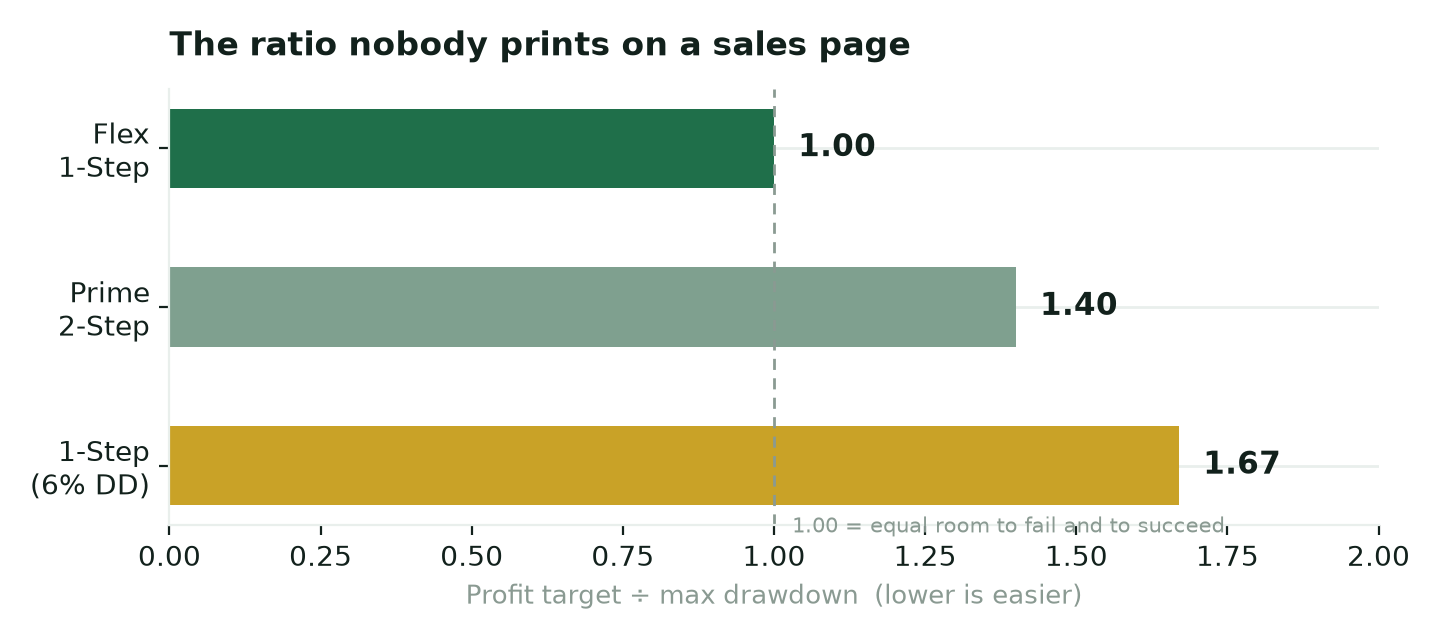
Target divided by drawdown: 1.00 means the evaluation gives you as much room to be wrong as it asks you to be right.
Then multiply by the fee. If a model with a one-to-one ratio takes me three attempts to pass at three hundred dollars a try, an account costs me nine hundred dollars. If the harder model takes five attempts, the same account costs fifteen hundred. A thirty percent discount code closes some of that gap and none of the difficulty. Buy the ratio first, the discount second.
That is the whole intellectual property of the site: the fee is not the price of an account, it is the price of one attempt, and the attempt is priced by the ratio. I have not seen a prop firm put that on a landing page, for the obvious reason that it makes the harder products look like what they are.
What is actually on the site
Eight calculators, each one solving a single question a funded trader has to answer before they risk anything:
- Position size, because lot size is a consequence of risk and stop distance, not a preference.
- Max drawdown, to convert a percentage into the actual cushion between your equity and the account dying.
- Daily loss limit, which turns a rule into a number of trades at your risk per trade, the form you can act on at nine in the morning.
- Profit target, to estimate how many trades at your average edge it will take to pass.
- Profit split, to see what a payout actually becomes after the split, the payout fee and any reserve.
- Risk of ruin, the least comfortable one, because it tells you how often a given risk per trade ends an account.
- Consistency rule, for firms that cap your best day as a share of total profit.
- Compounding, for what a scaling plan really does to your income over a year of cycles.
Around them sit seventeen guides. Each one attacks a rule that fails traders rather than a topic that reads well. Max daily drawdown measured on equity rather than balance. Static versus trailing drawdown. Weekend holding rules. News trading rules. Payout denials. Consistency clauses. The arithmetic of a 70 percent split versus a 90 percent split once you account for how often each one actually pays.
None of it is written to be exciting. The test I set myself for each piece was simple: after reading it, can someone answer a question about their own account with a number instead of a feeling. If they cannot, I cut it.
The trap I have fallen into twice already
Last year I wrote two hundred and six articles for a blog and AdSense rejected it for insufficient content. The lesson I took from that was about length. The lesson I should have taken was about intent.
Two hundred and six articles that nobody searched for is not a content problem, it is a demand problem. AdSense was not punishing me for short posts. It was looking at a site with no reason to exist and declining to pay for traffic that was never coming.
PropFirmMath starts from the other end. Every page begins with a question someone types into Google with money on the line: what lot size on a hundred thousand dollar account, what happens if I lose three trades in a day, is a ninety percent split worth a monthly payout cycle. The calculators are the answer and the articles are the explanation. The affiliate link comes after the number, not instead of it.
I may still be wrong. But if I am wrong here, I will be wrong in a way I can diagnose, because there is only one funnel: search for a rule, use the calculator, read the guide, click the firm. One path means one place to look when the graph is flat.
The first firm said yes
Affiliate approvals in this industry are not automatic. I applied to several prop firms in the same week. The first to approve was Blueberry Funded, which is broker-backed and runs three challenge models. Two days later FundedNext approved me at their Silver tier, and Goat Funded accepted the application as well.
Then the wall. FundedNext and Goat Funded both hold the tracking link behind an identity check: upload a government ID, wait for review, and only then does the partner portal hand you a code. That is entirely reasonable for a financial product and it is also two weeks of my marketing plan sitting in someone's compliance queue while I refresh a page. I have not uploaded the ID yet. Until I do, those two partners have approved me and cannot pay me.
Blueberry did not need any of that, so Blueberry got the work. I read every published rule on their comparison page, wrote a full review from those numbers rather than from a sales pitch, and dropped the affiliate link in behind a disclosure that says plainly that I earn a commission and that it never changes the numbers.
That review is now the most substantial thing on the site. It compares the three models by target, drawdown, split and target-to-drawdown ratio, works through what the fee actually costs per funded account, and then has a section headed, in effect, here is what is wrong with this firm. The honest arguments against are the reason I trust the page. A review with nothing negative in it is an advertisement.
Four charts because a number in a paragraph is easy to ignore
I put four graphs on that review page in the same week I published it. The first shows target against drawdown for each model. The second is the ratio on its own, with a line at one to one. The third shows cost per funded account at different pass rates and with the discount applied. The fourth follows a four thousand dollar payout cycle down through the split, the fee and the reserve until it becomes the number that reaches a bank account.
They took an evening to make and they changed how the page reads. A paragraph saying a ratio is 1.67 can be skimmed. A gold bar sticking out past the line cannot. That is not decoration, it is the argument, drawn.
It also taught me something about my own store. I have been publishing prose at scale for months and almost none of it shows a reader anything. The next round of buying guides on the health site will get the same treatment, because the same principle holds whether the product is a funded account or a bottle of berberine: show the comparison, do not merely assert it.
What I got wrong immediately
Two things, on the first day, and both are familiar.
The first was internal linking. I published the review and linked it from six guides, three calculators, the homepage and the guides index. What I did not do was link the guides to each other properly, which means a reader who arrives on the drawdown piece has no obvious path to the payout piece unless they scroll to a footer. On a site with seventeen articles that is survivable. At a hundred it is a crawl problem as much as a reader problem, and I have spent enough of this month watching Google treat a sitemap as a suggestion to know better.
The second was assuming that publishing is the end of a job. It is the middle. The review went live, and then I spent an hour doing arithmetic to check my own claims, because a page that sells a difficulty ratio had better not get the ratio wrong. It did not, but the check is now part of the process rather than an afterthought.
The part that is still uncomfortable
PropFirmMath has earned nothing. It has a handful of guides, eight calculators, one review and one affiliate approval. It has no traffic I can measure yet, no email list, and no proof that the search demand I believe exists is really there at the volume I need.
What it does have is a clean test. If the site is right, clicks will turn into funded accounts, and the commission will show up in a dashboard I can read without a spreadsheet. If the site is wrong, the calculators will get used and nothing will convert, which tells me the content is useful and the offers are mispriced. If both are flat, the demand was never there and I will have learned that for the price of a domain and two evenings.
I have spent most of this year building things and guessing afterwards whether they worked. The version of this diary that matters is not the one where every launch works. It is the one where every launch is measurable, so that the failure, when it comes, actually teaches me something.
If you trade, or you are thinking about paying for an evaluation, the calculators are free and the only thing I ask is that you run your own numbers through them before you read anyone's review, mine included.
Related entries from the journey
This is not the first time I have learned something expensive about building the wrong thing. I wrote about writing 206 articles for AdSense and getting rejected, about six months of writing into the void, and about what insufficient content actually means. The new site is my attempt to answer all three at once.
Newest entries from the diary
Written by Justice Manyika — Johannesburg, South Africa. This diary records my real journey, in my own words.
If this helped, follow the journey — drop your email in the box below and every new entry lands in your inbox. No spam, unsubscribe anytime.


Comments
Post a Comment