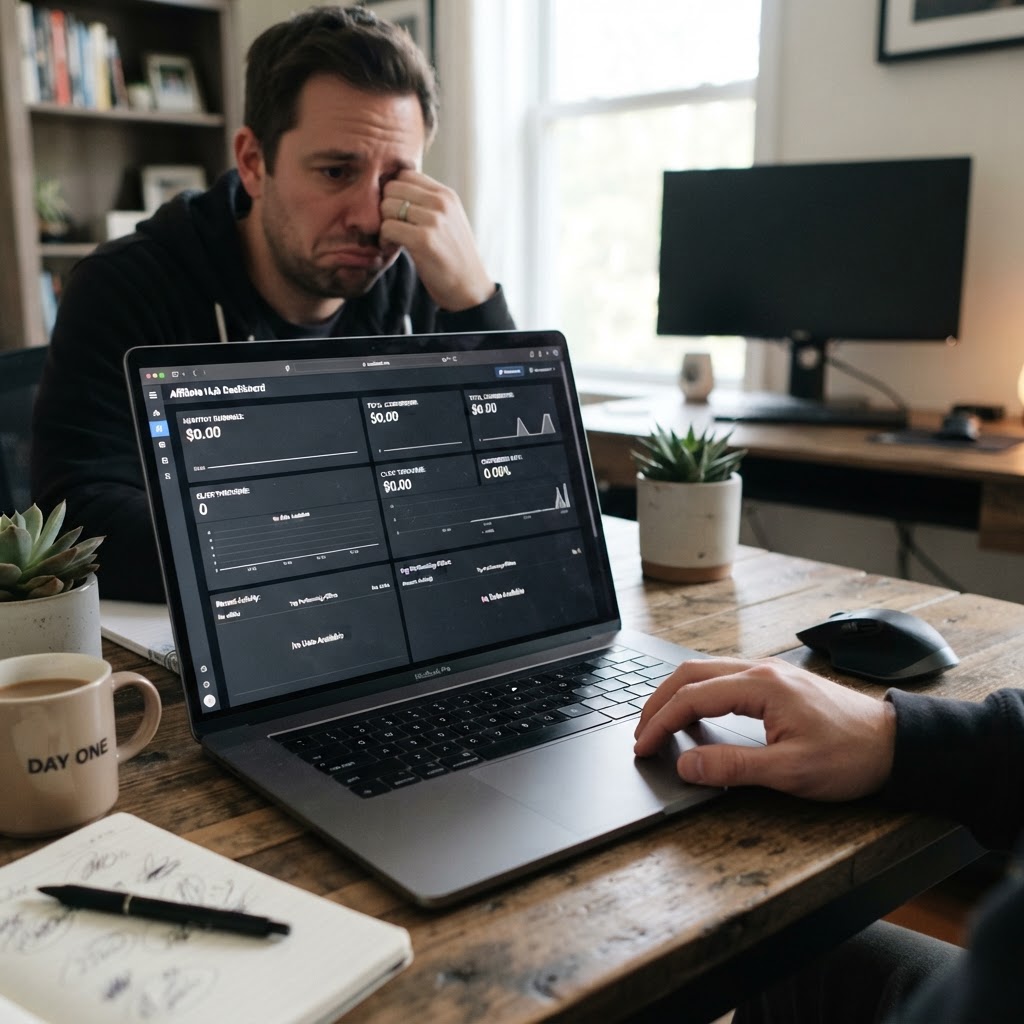
Thirty days. Zero dollars. I am not rounding down or being dramatic. I checked every dashboard , MaxBounty, ClickBank, Impact, Digistore24, Amazon Associates, WooCommerce. Every single one showed the same number in the earnings column: $0.00. One full month of writing, optimizing, posting, sharing, building, and the internet had decided to pay me nothing.
This was not my first month in the business. I had been at this for a while, entlek, I had been at this for too long with nothing to show for it. I had already earned a few commissions here and there . enough to know the system worked in theory, but not enough to call it an income. And now, after a month where I had worked harder than any previous month, I had earned less than I had in months where I barely touched the keyboard.
What I Did During the Zero Month
Let me tell you what I actually did during those thirty days, because the instinct when you earn zero is to assume you did nothing. I did not do nothing. I did more than most people do in a quarter.
I published twenty-three blog posts on vitaladge.com. Each one was SEO-optimized, 1,500 to 2,000 words, targeting long-tail keywords that I had researched using Google's autocomplete suggestions and free keyword tools. I wrote about joint supplements, blood sugar support, weight loss products, skin treatments ( products I was promoting through MaxBounty and ClickBank. I was not keyword-stuffing or writing thin content. I was writing genuine reviews with real product analysis, pros and cons, and honest recommendations.
I set up and configured the ViralForge video creator on my site : a tool that would eventually become part of my content pipeline for generating promotional videos. I spent days troubleshooting the WordPress integration, testing the video rendering, and making sure the output quality was acceptable.
I applied to twelve new affiliate programs across MaxBounty, Impact, and ClickBank. I got approved for four of them. I created dedicated landing pages for each new campaign, embedded tracking links, and wrote promotional content. I also got denied by several programs , Jasper, Copy.ai, Writesonic . which stung, but at least gave me information about what programs were looking for.
I posted on Instagram every day. I posted on Facebook three times a week. I engaged with comments, responded to messages, and tried to build a community around the VitalEdge brand. I was not buying followers or using bots. I was doing organic growth, jah neh, the slow, painful, unglamorous, I was trying to make um'gerezo.
I built the VitalEdge Affiliate Starter Pack , the $37 digital product that would go on to sell zero copies in its first month. That took three weeks of research, writing, and design work.
And at the end of all of that work . all of those hours, all of that effort, all of that creative output , the total revenue for the month was zero dollars. Not a single affiliate commission cleared. Not a single digital product sold. Not a single Fiverr order came in. Zero.
The Psychology of Earning Nothing
I want to talk about what it feels like to work for a month and earn nothing, because I think this is the experience that most online business guides skip over. They talk about the hustle, the grind, the sacrifice. They do not talk about the specific emotional texture of checking your dashboard for the thirtieth consecutive day and seeing zeros.
It starts with optimism. The first week, you are fine. You just published several new posts, you are excited about the new affiliate programs you joined, and you know that SEO takes time. The zeros in the dashboard do not bother you because you did not expect to see results yet. You are playing the long game.
The second week, the optimism thins. You check the dashboard and the zeros are still there, but now you are starting to do the mental math . how many hours you have worked, how many posts you have published, how many social media updates you have posted. The ratio of effort to results is not just bad, it is undefined, because you cannot divide by zero.
The third week is when the doubt arrives. Not about the business ( you still believe the business model works in theory : but about yourself. Maybe your writing is not good enough. Maybe your SEO is not as smart as you think. Maybe the products you are promoting are not what people want to buy. Maybe the problem is not the strategy but the strategist. This is the week where you start reading other people's success stories and wondering what they know that you do not. The answer, of course, is usually nothing , they just started earlier and have been in the zero-month phase that you are in right now. But you cannot see that when you are in it.
The fourth week is the hardest. This is when you start doing the thing that every failed entrepreneur does: mentally inventorying what else you could be doing with your time. The hours you spent writing blog posts could have been spent on a side job that pays a guaranteed hourly rate. The money you spent on hosting and tools could have been saved or invested. The social energy you spent on Instagram could have been spent on actual human relationships that give you something in return. Every choice you have made starts to look like a mistake, not because the choices were wrong, but because the results have not validated them.
And then the month ends. You look at the dashboard one final time. Zero. You close the laptop. And you ask yourself the question that every person in this position eventually asks: Should I quit?
Why I Did Not Quit
I did not quit. Not because I had some dramatic moment of clarity or a inspirational quote that turned things around. I did not quit for a very mundane reason: I had already invested too much to walk away.
This is what economists call the sunk cost fallacy, and it is usually cited as a reason to quit things. "Do not throw good money after bad." "Do not fall for the sunk cost fallacy." And that advice is correct in many situations. But there is a flip side that rarely gets discussed: sometimes the sunk cost is not a fallacy. Sometimes the investment you have made is real, the asset you have built has genuine value, and the only thing standing between you and a return on that investment is time.
I had a website with a hundred and eighty-seven blog posts. I had a WooCommerce store with a hundred and sixty-eight products. I had affiliate accounts with thirty-nine MaxBounty campaigns. I had a growing social media presence. I had a YouTube channel in development. I had skills . SEO, WordPress, affiliate marketing, content creation , that I did not have when I started. All of this was real. It had value. It just had not converted into revenue yet.
If I quit, all of that value would evaporate. The blog posts would stay online but would stop being updated and would gradually lose search rankings. The WooCommerce store would become a digital ghost town. The affiliate accounts would eventually be deactivated for inactivity. The social media presence would wither. The skills would atrophy. Quitting would not just mean stopping . it would mean watching everything I had built slowly decay.
So I did not quit. I opened my laptop on the first day of the next month and started writing again. Not with optimism , I was fresh out of that . but with a grim, stubborn determination that I can only describe as spite. Spite toward the zero in my dashboard. Spite toward the part of my brain that said I should give up. Spite toward the vague, undefined forces that had conspired to make my work worthless for thirty consecutive days.
What Happened After the Zero Month
The next month was not zero. It was not a breakthrough either ( it was a small, modest, unimpressive number that most people would not bother mentioning. But it was not zero. And the difference between zero and not-zero, in this business, is the difference between a model that does not work and a model that is simply slow.
What changed? Nothing, technically. I did not discover a new strategy or a secret keyword or a viral content format. I just kept doing what I had been doing — writing, posting, optimizing, promoting — and the compound effect of all that work finally started to show. Google indexed more of my pages. Social media posts reached a few more people. One of my blog posts started ranking on page two for a competitive keyword, and a trickle of organic traffic turned into a slightly larger trickle.
The lesson of the zero month is not that hard work always pays off. Hard work does not always pay off — not in the timeframe you want, not in the amount you expect, and sometimes not at all. The takeaway that in a compounding business — where each piece of content adds to the total, where each backlink strengthens the domain, where each social media post builds the audience — the zero month is not a reflection of your work. It is a reflection of the lag between work and results.
Every blog post I wrote during the zero month is still online. Every SEO optimization I made is still in place. Every affiliate link I embedded is still active. The work did not disappear because the revenue was zero. The work was building, accumulating, and compounding in the background, invisible in my dashboard but real in the structure of my business.
If you are in a zero month right now, here is what I want you to know: the zero is not a verdict. It is a lag. The work you are doing today is not showing up in tomorrow's dashboard, but it is showing up in next month's search rankings, next quarter's traffic, and next year's revenue. The only way to guarantee that the zero month becomes a permanent zero is to quit. Everything else — every day that you keep going despite the zero — is an investment in a future that your dashboard cannot yet see.
I did not quit during the zero month. And that decision, more than any strategy or tactic I have ever employed, is the reason I am still here.
Going through an entire thirty-day month of intense effort for $0.00 is a psychological test that few guides on online business adequately prepare you for. In South Africa, when you tell people you are working on an online business, there is already skepticism. Friends and family naturally ask how things are going, expecting to hear about sales or earnings. Having to smile and say 'it's growing' while knowing your bank account balance hasn't moved a single cent is exhausting and lonely.
During that zero month, I spent R650 on monthly data bundles and watched the Eskom prepaid electricity meter in my room beep angrily at 2 AM as the units ran low. Buying R150 of electricity units when your affiliate dashboards all show $0.00 creates a heavy, persistent anxiety. You start asking yourself if you are being delusional, if everyone who warned you that internet businesses don't work in South Africa was right, and whether you are wasting precious time that should be spent seeking traditional employment.
Instead of throwing in the towel, I decided to analyze the data objectively. I opened Google Analytics and WooCommerce reports side by side. The site had actually received over 2,100 pageviews during those thirty days. People were reading the blog posts, but nobody was clicking through to the affiliate products. The problem wasn't that the work was useless; the problem was that my call-to-actions were weak, my link placements were awkward, and I was writing generic reviews instead of solving specific user problems.
I realized that driving traffic is only half the equation. If you don't build trust and structure your articles to help the reader take the next logical step, thousands of visitors will read and leave without generating a single click. I spent the last week of that month rewriting product recommendations, adding clear comparison tables, and improving site loading speed. The zero month wasn't a failure of effort; it was an expensive lesson in conversion optimization that laid the foundation for every dollar I earned in the months that followed.





Comments
Post a Comment