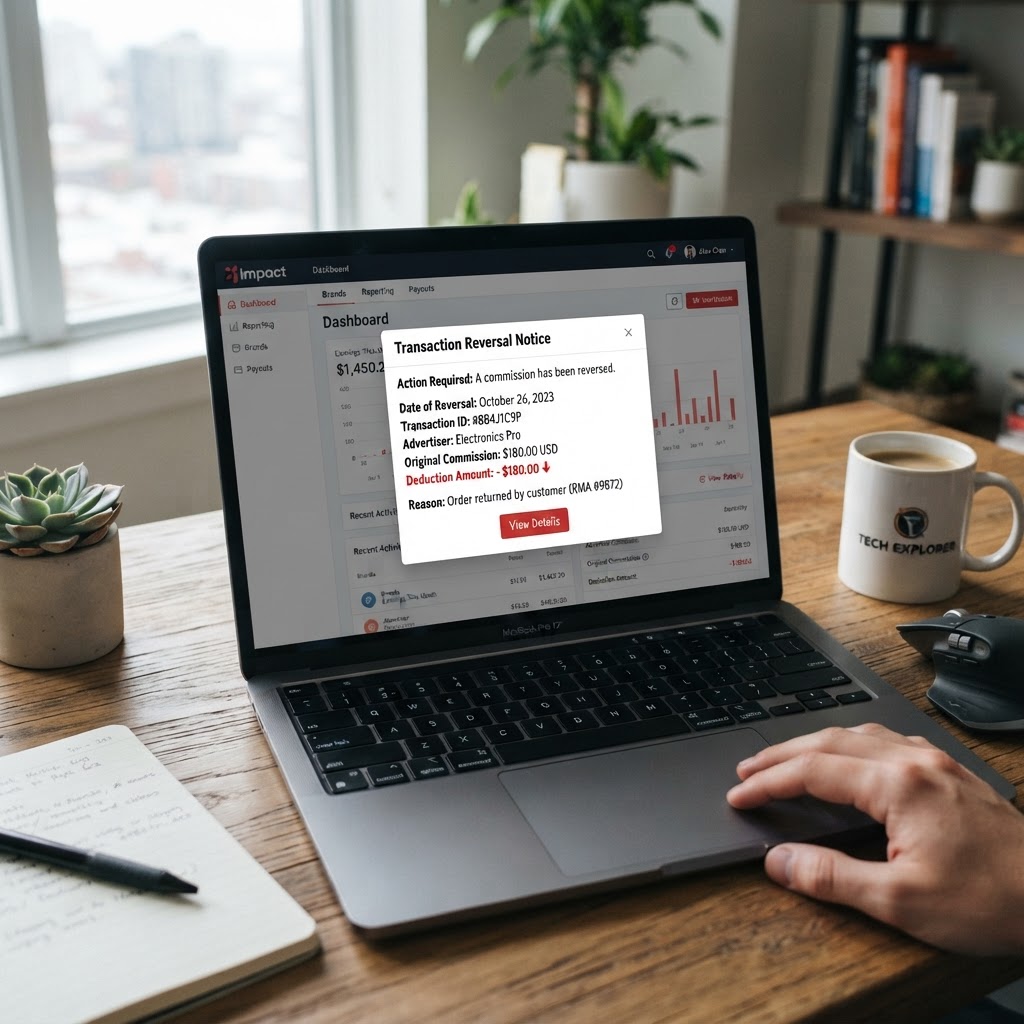
I remember the exact moment I saw it. I was sitting in my room in Carltonville, a mining town in the West Rand, it was maybe 11 PM, and YOH YOH, I had just opened my Impact dashboard, entlek, I was checking it for the fifth time that day to check on my commissions. I had been tracking a Wix referral for months , someone had clicked through my affiliate link, signed up for a premium plan, and the conversion showed as "pending" in my dashboard. The commission was $180. Not life-changing money, but when you have made almost nothing online, $180 feels like winning a small lottery.
And then it was gone.
The status had changed from "pending" to "reversed." No explanation. No email notification. No appeal process. Just a single word in red text next to the entry: Reversed. I stared at the screen for a good two minutes, refreshing the page three times as if the universe had made a mistake and would correct itself if I just reloaded enough. It did not correct itself. The $180 was gone, and it was not coming back.
How I Got the $180 in the First Place
To understand why this hurt so much, you have to understand how long it took to get there. I had joined Impact.com a few months earlier, hoping to diversify my affiliate income beyond MaxBounty and ClickBank. Impact had brands like Wix, HubSpot, and Semrush . companies with real name recognition and products I actually believed in. I figured if I could get approved for a few of these programs and drive traffic to them through my blog posts on vitaladge.com, I could build another income stream.
Wix was the one I was most excited about. I had used website builders myself ( I had built my entire affiliate store on WordPress through Hostinger : so I understood the value proposition. When people searched for "how to build a website" or "Wix vs WordPress" or "best website builder for small business," I wanted vitaladge.com to show up. I wrote comparison articles. I wrote tutorials. I wrote honest reviews. I embedded my affiliate links naturally within the content, not as pop-ups or aggressive banners, but as contextual recommendations that made sense within the narrative of each article.
And slowly, it worked. Traffic trickled in from Google search results. People clicked my links. A few of them signed up for Wix plans. And one of those signups converted into a $180 commission. It was the single largest affiliate payment I had ever earned at that point. I did not celebrate , I had learned by then that pending commissions can disappear . but I allowed myself to feel cautiously optimistic. I checked the dashboard every few days, watching the pending status hold steady, counting the days until the lock period expired and the commission would become permanent.
The lock period was 90 days. Ninety days of waiting, checking, and hoping. And on day 87, three days before the commission would have been locked and paid out, the reversal happened.
What a Reversal Actually Means
Here is what most people do not understand about affiliate marketing: a conversion is not a sale. It is a promise of a sale. When someone clicks your link and makes a purchase, the affiliate network records the transaction as "pending." The merchant then has a window , usually 30, 60, or 90 days . during which they can reverse the commission if the customer refunds, cancels, or if the transaction is deemed fraudulent.
In my case, the Wix customer had cancelled their subscription within the refund window. Wix processed the refund, and under the terms of the affiliate agreement, that meant the commission was clawed back. From Wix's perspective, this was perfectly logical , they did not get paid, so I should not get paid. From my perspective, I had done my job. I had referred a real person who genuinely signed up for a real plan. I had no control over whether that person decided to cancel three weeks later. But I bore the cost of their decision.
This is the dirty secret of affiliate marketing that nobody talks about in their YouTube tutorials. They show you screenshots of $10,000 months and talk about passive income and financial freedom. They do not show you the reversals. They do not show you the commissions that vanish overnight. They do not show you the months where you earn $200 and then lose $180 of it to a reversal you had no way of preventing.
I Emotional Toll of Watching Money Disappear
I want to be honest about something that I think a lot of people in this space feel but rarely admit: when you are struggling to make money online, every dollar matters more than it should. Not because you are greedy, but because each dollar is proof that what you are doing is working. Each commission, even a small one, is validation. It is evidence that the hours of writing, the SEO research, the social media posting, the late nights . all of it is adding up to something real.

So when a commission gets reversed, it does not just take away money. It takes away validation. It makes you question whether the whole thing is working at all. For about 48 hours after the reversal, I was in a dark place with this project. I opened my laptop, looked at my blog, and felt nothing. Not anger, not motivation, just a flat emptiness. The kind where you start doing math in your head ( how many hours I had spent writing that Wix comparison article, how many hours optimizing it for SEO, how many hours building backlinks — and dividing those hours by the commission I no longer had. The hourly rate was not just bad. It was negative.
But here is what I learned from that experience, and it is something I want anyone reading this to understand: reversals are not failures of your marketing. They are a structural feature of the affiliate business model. Every affiliate marketer deals with them. The successful ones are not the people who never get reversals — they are the people who build enough volume that a single reversal does not matter. They are the people who earn $2,000 a month and can absorb a $180 reversal without blinking, because they know five more commissions are coming next week.
I was not there yet. I was at the stage where $180 was a significant percentage of my monthly earnings. But I understood, even in that moment, that the solution was not to fight the reversal. The solution was to grow past it.
How Impact.com Support Rabbit HoleI did what any reasonable person would do — I tried to get my money back. I opened a support ticket with Impact.com, explaining that the reversal seemed premature given that the lock period had not yet expired. I asked if there was an appeal process, a waiting period, or any mechanism to dispute a reversal.
The response I got was polite, professional, and completely unhelpful. They explained that reversals are initiated by the merchant, not by Impact, and that Impact has no authority to overturn a merchant's decision. They suggested I contact Wix's affiliate team directly, which I did. Wix's response took eleven days and consisted of a single paragraph confirming that the customer had cancelled within the refund window and that the reversal was therefore valid under the terms of the affiliate agreement.
I read the terms of the affiliate agreement. They were right. The reversal was valid. There was no loophole, no appeal, no exception. I had agreed to these terms when I joined the program, and the terms were doing exactly what they were designed to do — protect the merchant from paying commissions on refunded transactions.
This was another one of those moments where I realized that affiliate marketing, despite all the "be your own boss" rhetoric, is not really a business you own. You are a partner, not an owner. The merchant controls the product, the pricing, the refund policy, and the commission reversal process. The network controls the tracking, the payout schedule, and the terms of service. You control exactly one thing: traffic. And even that control is tenuous, because it depends on Google's algorithm, social media platforms' policies, and the continued existence of the programs you promote.
What I Changed After the Reversal
I did not stop promoting Wix. That would have been an emotional decision, not a strategic one. The reversal was a one-time event, and Wix remained a good program with competitive commissions. What I changed was my approach to revenue diversification.
Up until that point, I had been spreading my effort across multiple programs but still depending on any single commission for a meaningful percentage of my income. The Wix reversal taught me that concentration risk is real even in affiliate marketing. If one reversal can wipe out a significant portion of your monthly earnings, you are too concentrated.
So I doubled down on MaxBounty, which had shorter lock periods and a wider variety of campaigns. I continued building my ClickBank portfolio, which had different reversal dynamics. I kept the Wix program active but stopped relying on it as a primary income source. And I started thinking about my own products — things I could sell directly, without a merchant between me and the customer who could reverse the transaction.
That, ultimately, is what led to the VitalEdge Affiliate Starter Pack. Not the reversal itself, but the realization that came from it: if I wanted real control over my income, I needed to sell something I owned. Affiliate marketing would always have reversals. My own products would not.
The Lesson Nobody Puts in the Course
If there is one thing I want you to take away from this post, it is this: affiliate marketing is a real business, but it is a business with training wheels. You do not control the product. You do not control the refund policy. You do not control the commission structure. You can be doing everything right — driving genuine traffic, referring real customers, building honest content — and still lose money you earned because someone on the other end of the transaction changed their mind.
This is not a reason to quit. It is a reason to understand the game you are playing. Reversals will happen. Plan for them. Build volume so that no single reversal can break your month. And eventually, start thinking about products of your own, where the only person who can reverse your commission is you.
I still check my Impact dashboard. The $180 reversal from Wix is still there in my history, a permanent record of the day I learned that pending is not the same as earned. But these days, it is a footnote, not a crisis. I have learned to treat pending commissions as if they do not exist until they are locked and paid. It is a small mental shift, but it has saved me from the emotional rollercoaster of watching numbers that might disappear.
The $180 taught me more about the reality of this business than any course or tutorial ever did. And for that, at least, it was worth the loss.
When that $180 Wix commission status turned from 'pending' to 'reversed' on my Impact dashboard, the blow was financial as well as emotional. In USD terms, $180 might seem like a small line item to a major corporate affiliate program. But in South Africa, converted at the exchange rate of R18 to the dollar, $180 represented over R3,200 ZAR. That was enough money to cover my room rent for a month, buy three months of high-speed internet data, and pay off my web hosting renewals for the next year.
I had already mentally allocated those funds in my head. I had planned how I would use that payout to ease my monthly expenses and reinvest a portion back into better keyword tools. Seeing that R3,200 vanish in a single second with no explanation or right of appeal was a harsh reality check. It felt like someone had reached into my pocket and taken cash I had already earned, leaving me sitting at my desk late at night staring blankly at a red status label.
That reversal forced me to institute strict financial accounting rules for my business. I opened my tracking spreadsheet and created a hard rule: pending commissions are treated as zero value. Until money is locked, approved, and physically deposited into my Payoneer or Capitec account, it does not exist in my accounting ledger. I stopped checking pending balances daily to avoid the emotional rollercoaster of watching unconfirmed numbers fluctuate.
Furthermore, that loss taught me the importance of building volume and diversifying merchants. Relying heavily on one single high-ticket commission leaves you vulnerable to reversals, chargebacks, or merchant policy changes. By spreading recommendations across multiple reliable networks and focusing on steady recurring micro-commissions, no single reversal can ever derail my monthly budget again. The $180 lesson was painful, but it made me a far more pragmatic and resilient entrepreneur.




Comments
Post a Comment