Instagram and I have a complicated relationship. The platform gives me reach to potential customers in a format that actually works for product marketing , visual, scrollable, shareable. But Instagram also rate-limits me periodically, and when it does, it feels like being grounded by a parent who won't explain what you did wrong.
Instagram rate limit ( the reality of social media marketing
Inside First Time It Happened
I was posting three times a day. Morning, afternoon, evening. Product images, lifestyle shots, occasional motivational text. My follower count was growing slowly but steadily : thirty new followers a week. Engagement was decent. A few likes, a comment here and there, occasional saves. Nothing viral, but consistent growth.
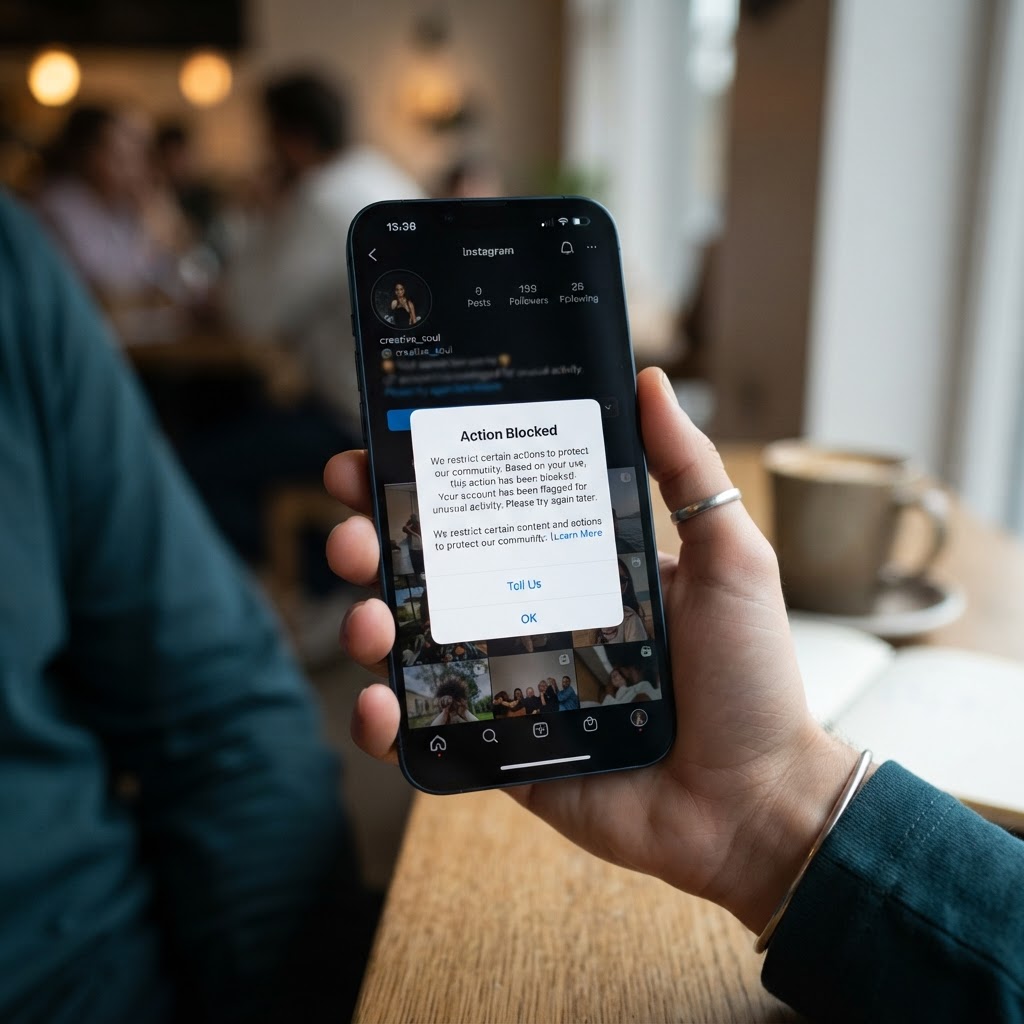
Then one morning, I tried to post and got a notification: "Action Blocked. We restrict certain actions to protect our community. Tell us if you think we made a mistake." I couldn't post. I couldn't like. I couldn't comment. I couldn't even follow new accounts. My account was frozen, and the only option was a "let us know" button that led to a form asking for my government ID.
My first thought was panic. Had I been permanently banned? Was my account going to be deleted? Was the Instagram handle I'd built over months , @vitaladge.store . going to disappear?Inside Waiting Gameh2>
I submitted the ID verification. Then I waited. And waited. Instagram doesn't tell you how long the review takes. It could be hours, days, or weeks. During that time, my account existed in a limbo , visible to existing followers but unable to take any action. It was like being at a party where you can see everyone but can't talk.
The block lasted four days. When it lifted, I got no explanation. No email. No notification. Just suddenly, I could post again. The silence was almost worse than the block itself . at least if they told me what I'd done wrong, I could avoid doing it again.
How Pattern
n
Over the following months, the rate limiting became a pattern. Every few weeks, Instagram would throttle my account. Sometimes for a day, sometimes for three. Each time, the same generic notification. Each time, no explanation. I started keeping track and noticed a pattern: the blocks usually came after I increased my posting frequency or used hashtags that Instagram's algorithm associated with spam.
But here's the frustrating part: the hashtags I was using weren't spam. I was using tags like "affiliate marketing," "online business," "passive income" , the same tags every legitimate business account uses. The algorithm doesn't distinguish between someone genuinely building a business and someone running a bot farm. If your behavior pattern matches a bot . frequent posts, similar content, external links ( you get treated like one.
What I Changed
I reduced my posting frequency to once a day. I diversified my hashtags. I started posting more personal content : behind-the-scenes shots, my workspace, my process — mixed in with the product posts. I engaged more genuinely with other accounts before posting my own content. The rate limiting became less frequent, though it never fully stopped.
I also accepted a hard truth: Instagram is a rented platform. I don't own my follower list. I don't own my content's reach. At any moment, the algorithm can change, my account can be limited, or my reach can drop to zero. This is why I diversified into YouTube, where I own my channel and subscribers, and into organic search, where Google's traffic is more stable than Instagram's mood swings.
Before Cost of Rate Limiting
g
Each rate-limit episode cost me momentum. When your account is frozen for three days, the algorithm resets your engagement score. When you come back, your posts reach fewer people. It takes a week of consistent posting to recover the reach you had before the block. In that week, you're reaching 30% fewer potential customers.
Over a year, with four or five rate-limit episodes, that's a month of reduced reach. A month of lower engagement. A month of fewer affiliate clicks. The cost isn't just inconvenience — it's real revenue left on the table because an algorithm decided your behavior was suspicio
How Lesson About Platform Dependency
ency
The Instagram rate limiting taught me the most important lesson about platform-based marketing: never build your entire business on one platform. Instagram is a tool, not a foundation. The foundation is your website, your email list, your search rankings — things you control. Social media is the top of the funnel, not the bottom.
I still use Instagram. I still post daily. But I treat it like a billboard, not a home. The content lives there temporarily, drives traffic to my website, and then becomes irrelevant. The real business happens on vitaladge.com, where I control the user experience, the monetization, and the data.
Every time I get rate-limited now, I remind myself: this is exactly why I built a website. This is exactly why I'm pursuing AdSense. This is exactly why I diversify. Instagram can take away my reach, but it can't take away my search rankings. And those rankings are what build a business that lasts.
The 429 Error on a 15GB Vodacom Bundle
It was a stifling Thursday afternoon in Johannesburg when my social media operation came to a grinding halt. I was sitting at a small wooden corner table inside a crowded coffee shop in Rosebank, paying R55 for a flat white just to justify occupying table space and using their power socket. I had tethered my refurbished laptop to my mobile phone hotspot, powered by a 15GB Vodacom prepaid data bundle that had cost me R249 earlier that morning—money taken straight out of my personal Capitec savings account. My strategy for the day was aggressive: upload three new product review carousels, update several profile bio links, and manually send follow-up messages to users who had interacted with my recent story posts about tech accessories and affiliate offers.
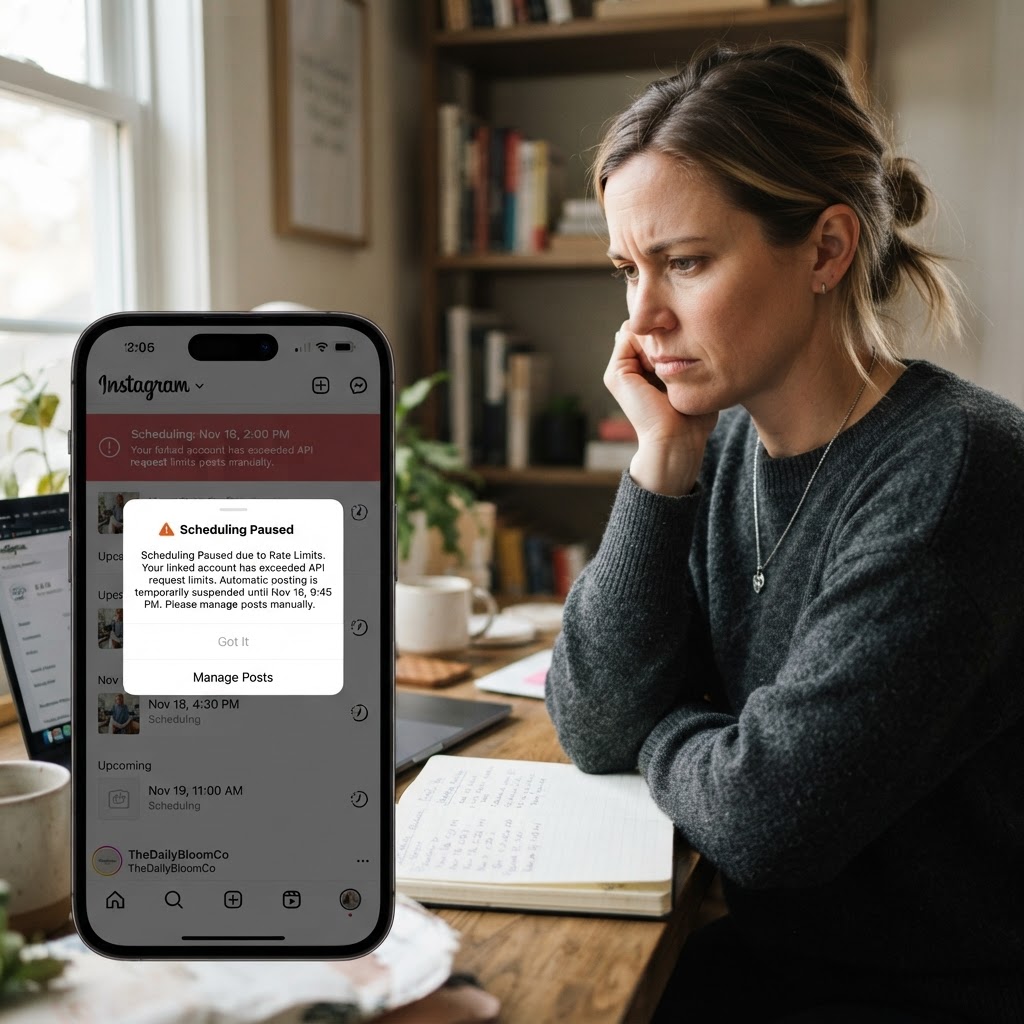
Without warning, my mobile screen froze. A sharp modal dialog popped up across the Instagram app interface: "Action Blocked - Try Again Later." I quickly switched tabs on my laptop browser, refreshed my Meta Business Suite dashboard, and was greeted by a stark, plain-text HTTP 429 error page: "Too Many Requests." The sudden roadblock felt like a punch in the stomach. I sat quietly in the noisy cafe, staring at the screen while the ambient hum of conversation and coffee grinders played around me. My immediate feeling was sheer panic. Was my primary account shadowbanned? Had Meta's automated anti-spam algorithms permanently blacklisted my domain name or IP address? When your entire user acquisition model relies on daily social traffic, an action block feels less like a temporary system hiccup and more like being locked out of your own physical storefront without a key or an appeal process.
The Technical Mechanics of Meta's Rate Limiter
Over the next forty-eight hours, I stopped trying to force posts through the blocked app and began studying how Meta's rate-limiting systems actually operate under the hood. Instagram's security infrastructure utilizes automated rate-limiting algorithms designed to shield server clusters from excessive API requests and crawler bots. These security systems continuously monitor request frequency, session token age, user-agent headers, and public IP address reputation. What I had completely overlooked in my daily hustle was the unique reality of South African mobile telecommunications infrastructure.
In South Africa, major mobile network operators like Vodacom and MTN employ Carrier-Grade NAT (CGNAT) to conserve limited public IPv4 address spaces. This means that hundreds of individual mobile subscribers connected to a single cell tower in Rosebank, Braamfontein, or Sandton share the exact same public IPv4 address. When multiple users or background scraping tools on that shared cellular tower burst outbound traffic simultaneously, Meta's automated threat detection system flags the shared public IP address. When combined with my own rapid manual posting, link updating, and automated status checking scripts, my session crossed Meta's rate-limit threshold. Suddenly, every subsequent request triggered automated security challenges, demanding SMS One-Time Passwords (OTPs) sent to my South African +27 mobile number and locking out my posting privileges for twenty-four hours at a time.
Loadshedding, Power Banks, and Stale Cookies
To complicate matters further, Stage 4 loadshedding was implemented across Johannesburg at 16:00 that same afternoon, cutting electrical power across the suburb and blacking out local Wi-Fi networks and neighborhood fiber nodes. I was forced to pack up my laptop, head back to my flat in Melville, and operate off a 20,000mAh portable power bank to keep my laptop battery alive while relying on a weak 3G cellular fallback connection. In an effort to bypass the action block, I cleared my browser cache, wiped stored local session cookies, and tried logging in using an MTN SIM card to fetch a fresh public IP pool.
Instead of solving the problem, this aggressive IP switching triggered Meta's location fraud security flags. Because my active session locations were jumping rapidly between dynamic cellular IP pools while cell towers cycled power during the four-hour blackout, Instagram flagged my account for suspicious activity. I spent two frustrating hours trapped in an SMS verification loop, waiting for OTP validation codes that were severely delayed due to congested cell tower battery backups. It was an exhausting, eye-opening lesson on the vulnerabilities of running a digital business dependent on third-party mobile apps while battling local infrastructure challenges. My monthly server hosting bill of R220 on Capitec was due in three days, and my primary traffic funnel was completely frozen.
Building Buffers and Humanizing Python Requests
Once full account access was finally restored thirty-six hours later, I realized I needed to completely overhaul my technical workflow and custom Python automation scripts. Trying to push any social platform API or web interface to its maximum limit is a dangerous game. I refactored my automation scripts to enforce randomized exponential backoff delays rather than fixed interval posting schedules. Instead of executing requests at fixed ten-second intervals, I introduced randomized sleep pauses between every action: time.sleep(random.uniform(45, 120)).
Furthermore, I implemented user-agent header rotation, proper HTTP session management, and strict daily interaction limits—capping manual and automated engagements at no more than twenty-five high-quality interactions per day. Crucially, I accepted that Instagram's platform is fundamentally engineered for human consumer browsing, not rapid-fire affiliate link distribution. Treating a social platform like a high-speed broadcast network will trigger rate limits every time, regardless of how sophisticated your proxy configuration or script design might be.
Renting Land vs. Owning the Infrastructure
The ultimate takeaway from this rate-limit ordeal was strategic rather than technical. Building your livelihood on rented digital land—whether on Instagram, Facebook, TikTok, or YouTube—means you operate at the mercy of algorithms, security heuristics, and terms of service that change without warning. On Meta's platforms, you are merely a guest on someone else's property. An unexpected rate limit, account suspension, or algorithm tweak can wipe out your customer reach overnight, leaving you with zero customer support, no hotline to call, and no recourse.
This experience forced me to pivot my primary focus toward owned digital assets: a self-hosted WordPress blog running on a private Linux VPS, an independent email newsletter list managed via MailerLite, and long-term organic search engine optimization. Paying R120 per year for a custom .co.za domain registration gives me total digital ownership. On my own domain, there are no arbitrary rate limits, no shadowbans, and no sudden security verification locks. Social media channels remain valuable for top-of-funnel discovery, but true long-term financial independence requires building on infrastructure that you own and control completely.




Comments
Post a Comment