It was 2:47 AM on a Tuesday when it happened.
I wasn't supposed to be awake. I had work the next morning , the real job, the one that pays rent. But I'd gotten into this habit of checking my MaxBounty dashboard before bed, the way some people check their phone for messages. Most nights it was zeros across the board. Clicks, but no conversions. Traffic, but no sales. I'd started to wonder if the whole thing was a scam . not the affiliate programs, but my belief that I could make any of this work.
But that night, the dashboard was different.
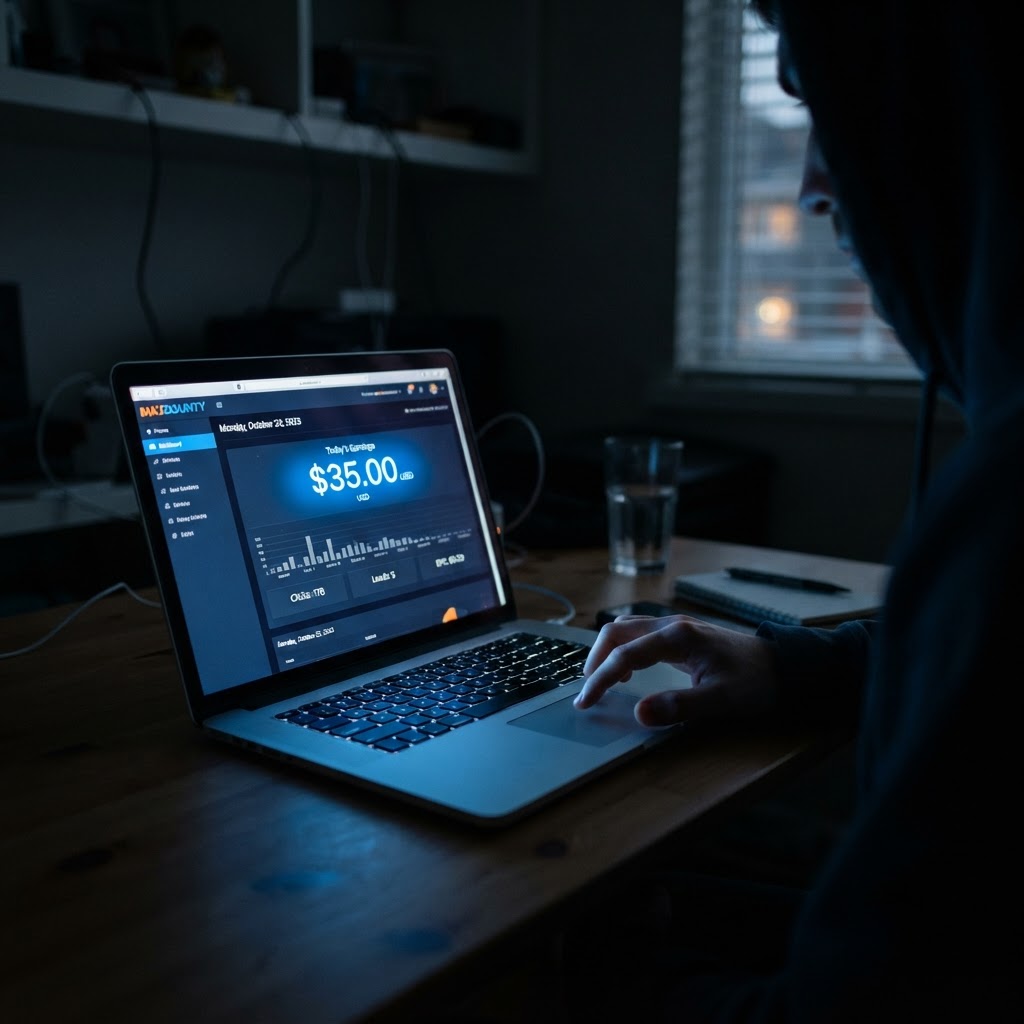
There it was. One line. One conversion. 2.50.
I stared at it for a full minute. Then I refreshed the page, thinking it was a glitch. It was still there. I refreshed again. Still there. I screenshotted it. I opened the screenshot. I zoomed in. YOH YOH YOH. I read the campaign name three times to make sure it was real. Thank God. Dankie. Even you, fooza — the internet — you came through.
It was a health supplement offer ( one of the MaxBounty campaigns I'd added to the store weeks earlier. Someone had clicked through from vitaladge.com, landed on the offer page, and actually bought something. A real person. Somewhere in the world, a stranger had looked at a product on my website and decided to spend money.
And I got paid for it.
The Math That Kept Me Going
Forty-two dollars and fifty cents. Let me be honest about what that number meant in context. I had spent months building the site. I had paid for hosting. I had written dozens of blog posts. I had configured WooCommerce products, tested tracking links, set up analytics, redesigned the layout three times. If you counted the hours, I was probably earning about twelve cents per hour of work.
But that's not how I saw it.
I saw it as proof. Proof that the system worked. Proof that the pieces I'd been assembling : the blog posts, the product pages, the SEO, the social media , they were all connected to something real. The money wasn't the point. The point was that a complete stranger had found my website, trusted what they saw enough to click, and a company had tracked that click back to me and paid me for it. The entire chain worked.
If one person could do it, so could ten. If ten, then a hundred. The math was simple . I didn't need a viral hit or a million followers. I needed a hundred people a month to do what that one person had done. That was it. A hundred conversions at roughly forty dollars each would be four thousand dollars a month. That would change my life.
I stayed up until 4 AM that night. Not celebrating , planning. I opened a notebook and started writing down everything I thought had led to that conversion. Which blog post had the person likely read? Which product page had they clicked from? Was it the Facebook page? The Instagram account? Direct traffic? I had Google Analytics open in one tab and MaxBounty in another, trying to reverse-engineer the path that had led to my first real income online.
What I Carried Forward From 2.50
If I think about it, that first commission taught me three things that I still carry with me.
First, trust is built in layers. The person who bought didn't land on a product page and click "buy" immediately. They probably read a blog post first. Maybe two. Maybe they came back a week later. The content I'd written . the reviews, the comparisons, the "things I learned" posts , that was the real work. The product links were just the bridge between someone's curiosity and their wallet.
Second, patience isn't optional in this business. I had been writing and building for months before that first conversion. If I had quit in week six or week eight — which I almost did — I would have never seen it. The work I did today wouldn't pay off for weeks or months. That was the hardest thing to accept about affiliate marketing: you do the work now, and the reward comes later. Sometimes much later.
Third, one conversion is a data point, not a pattern. I wanted to believe that first sale meant the floodgates were opening. They weren't. It took another three weeks before the second one came through. Then another two weeks. The conversions were slow, unpredictable, and maddeningly irregular. But they were happening. And each one validated the same thing: the system worked.
The Day After
The next morning I went to work like nothing had happened. Nobody knew. I didn't tell anyone — what was I going to say? "I made forty-two dollars on the internet last night"? It sounded ridiculous. But I kept thinking about it all day. Sitting in the office, doing my job, I kept sneaking glances at my phone, checking if there had been another conversion.
There hadn't. But I didn't care. Something had shifted. For the first time since I started this journey, I wasn't just hoping — I knew. I knew it was possible because I had evidence. Not a YouTube guru telling me "you can do it." Not a course seller promising "six figures in six months." Just a number on a dashboard: 2.50. Small, unglamorous, and more motivating than any motivational video I'd ever watched.
That night, after work, I sat down and started writing a new blog post. Then another. Then I added two more products to the store. Then I rewrote the About page to sound more like a real person and less like a template. The first commission hadn't just given me money — it had given me direction. I knew what to do now. Keep writing. Keep building. Keep linking. Wait.
And that's exactly what I did.
— Justice
How 2:47 AM Glow of a Cheap Laptop Screen
The room was completely dark except for the harsh blue light reflecting off my laptop screen. It was 2:47 AM on a freezing Tuesday morning in Johannesburg. Outside my window, the street was dead quiet, save for the occasional distant hum of a passing delivery vehicle on the main road and the soft squeak of my bedroom ceiling fan spinning overhead. I was beyond exhausted. I had worked a full nine-hour shift at my corporate day job earlier that day, followed by five straight hours of late-night blogging, link checking, and server troubleshooting.
I had developed a compulsive habit of checking my MaxBounty affiliate dashboard right before closing my laptop to sleep, the same way most people compulsively check social media feeds. For months, that dashboard had been a dismal wall of zeros: 0 clicks, 0 conversions, $0.00 revenue. I was on the verge of giving up, convincing myself that affiliate marketing was an overhyped myth designed to sell online courses. But when I refreshed the browser page at 2:47 AM, the table was different. Right beneath the campaign column, a single line appeared: 1 Conversion - $2.50. I froze in my chair, staring at the numbers for a full minute in complete disbelief.
Converting Dollars to Rand: What R46.25 Actually Means
My initial reaction was skepticism. I assumed it was a reporting bug or a temporary UI display glitch. I pressed Ctrl+F5 to hard-refresh the page, bypassing the browser cache. The $2.50 entry remained firmly on the screen. I opened my browser dev tools, inspected the network response, and took three separate screenshots on my phone just to prove to myself in the morning that I hadn't imagined it. I immediately opened a calculator tab to convert $2.50 USD into South African Rand at the prevailing exchange rate of R18.50 per dollar: exactly R46.25 ZAR.
To an established business owner, R46.25 is pocket change, barely enough to buy a cup of coffee. But in Johannesburg, R46.25 has tangible, everyday value. It covers a loaf of Albany brown bread (R18.99), a 2L bottle of Clover full-cream milk (R33.99), or two full single-fare trips on a minibus taxi from Braamfontein to Park Station. More importantly, that R46.25 represented a profound psychological breakthrough. It was living proof that lines of Python code written in a tiny bedroom in South Africa could capture commercial intent from a customer thousands of miles away in North America and convert it into real currency deposited into my Capitec bank account.
Deconstructing the Anatomy of the Conversion
Unable to sleep, I spent the next hour digging through server access logs and MaxBounty tracking parameters to trace how that conversion occurred. The tracking ID showed that a user residing in Dallas, Texas had executed a Google search for a specialized joint health supplement review at approximately 19:15 US Central Time. They had landed on my self-hosted WordPress blog review article, spent two minutes reading my breakdown, clicked my embedded affiliate redirect link, and completed a single-page email submission form on the merchant's landing page.
The beauty of this transaction was its asynchronous nature. While I was lying in bed in Khutsong, thousands of miles away across the Atlantic Ocean, a server in North Carolina was serving my web page, executing tracking scripts, and crediting my affiliate account. I hadn't talked to the customer, I hadn't handled physical inventory, and I hadn't provided manual customer support. Software and organic search indexing had executed the entire commercial cycle automatically while I was preparing for bed.
The Exhausted Morning Commute with a Secret
When my alarm rang at 05:45 AM just three hours later, I woke up feeling surprisingly energized despite the severe lack of sleep. I dressed quickly, grabbed my backpack, and walked out into the crisp morning air to catch the 06:15 AM minibus taxi into the Johannesburg central business district. Sitting squeezed in the middle row of the taxi, listening to Amapiano tracks playing over the vehicle's speakers while watching the morning traffic crawl along Empire Road, I felt like I was carrying a secret superpower.
Everyone around me on that crowded taxi was heading toward a traditional 9-to-5 job, trading physical time and manual labor directly for a hourly wage. Looking out the window at the morning mist lingering over the skyline of Hillbrow, I kept reopening the screenshot of that $2.50 conversion on my phone screen. I knew I was still miles away from financial freedom, but the mental barrier had been permanently shattered. The digital commerce model was real, it worked, and I now possessed the exact blueprint required to scale it.
The Mirage of Instant Scaling and the Dry Spell
In the days that followed that first commission, I fell into the classic beginner's trap of naive extrapolation. I opened a spreadsheet and began calculating wildly optimistic projections: "If I make 1 conversion per day, that's $75/month. If I make 10 conversions per day, that's $750/month (over R13,800 ZAR!)." I convinced myself that I was just weeks away from quitting my day job and blogging full-time.
Reality brought me crashing back to earth very quickly. Over the next seven consecutive days, despite publishing three new articles and checking my dashboard every few hours, my conversion count returned to a brutal zero. I logged 184 clicks across various offer links, but not a single user completed a lead form or purchased a product. That initial dry spell taught me a vital lesson in humility: a single conversion proves that your system works, but building a consistent, scalable digital income requires systematic content creation, relentless keyword research, and the emotional fortitude to endure long stretches of zero revenue without losing momentum.
During those quiet days of zero conversions, I resisted the urge to panic or drastically alter my working site setup. Instead, I used the time to systematically audit every outbound affiliate link on my blog, ensuring proper HTTPS tracking tags were attached and testing page loading speeds across mobile connections. That single $2.50 commission became the permanent foundation of my confidence—a constant reminder that beneath the frustrating noise of algorithm changes and dry spells, the core digital engine remains completely sound.




Comments
Post a Comment