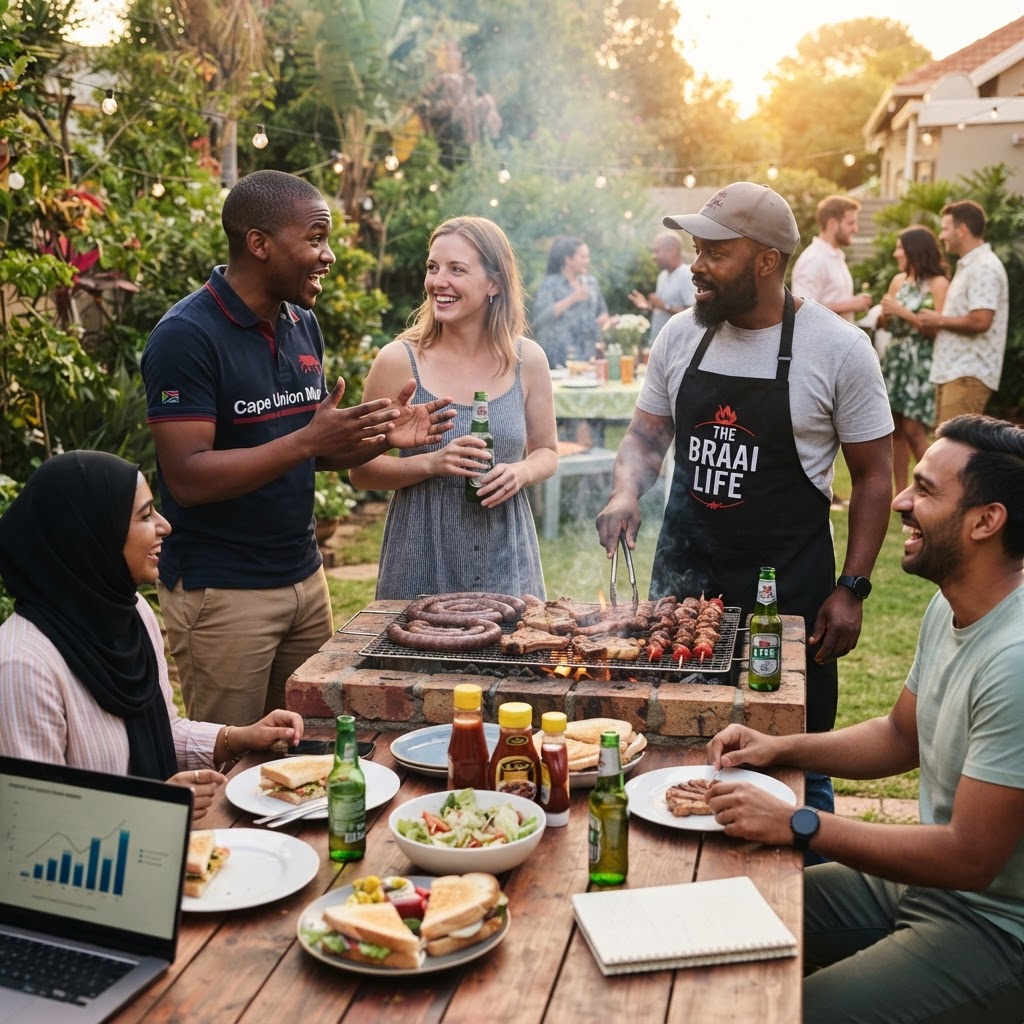
"So what exactly do you do?" The question comes at every braai, every family gathering, every taxi ride where the driver makes small talk. And every time, I have to decide how honest to be.
Because the truth , that I run an affiliate marketing blog, a YouTube automation pipeline, a WooCommerce store with 197 products, a trading bot on MT5, and a Blogger site with 250 articles about geography . is not an answer that fits into the mental categories people have for "jobs." It doesn't fit into "he works at a company" or "he's in IT" or "he has a business." It's something else entirely, and something else makes people uncomfortable.
My family knows I "work on the internet." That's the phrase my mother uses when she explains it to her friends at church. "He works on the internet." It's said with a tone that suggests she's not entirely sure it's real, but she's choosing to believe in it the way she chooses to believe in the stock market ( it exists, people make money from it, she doesn't understand how, and she hopes her son isn't losing money.
My father, before he passed, asked me every time I visited: "When are you getting a real job?" He wasn't being cruel. He was being practical. He'd worked at the same company for thirty years. The concept of making money without an employer, without a payslip, without a pension, was as foreign to him as speaking Mandarin. He worried about me. I could see it in his eyes every time I said "the business is growing." He heard "I'm unemployed and too proud to admit it."
Plainly stated somewhere in between. I'm not unemployed. I'm not employed either. I exist in a space that the previous generation doesn't have a word for, and the absence of a word makes them nervous.
My friends think I'm a hustler. That's the word they use. "Justice is hustling." It's meant as a compliment, but it carries a subtle implication : hustling is what you do when you don't have a real plan. It's The distance between ambition and stability. It's what people do before they figure out what they actually want to do.
They see me posting on Facebook at midnight, publishing YouTube videos they don't watch, talking about "SEO" and "affiliate links" and "conversion rates" in ways that sound like a foreign language. They nod politely. They say "that's cool, man." And then they ask if I've seen the Champions League match.
I don't blame them. Before I started, I didn't know what affiliate marketing was either. I didn't know that you could earn commissions by linking to products. I didn't know that Google's algorithm could make or break a business. I didn't know that a six-line file called robots.txt could be the difference between profit and loss. This world is invisible to anyone who isn't in it.
The people I went to school with , the ones with corporate jobs, medical aid, and retirement annuities . they imagine something different. They think I'm a dreamer. They think I'm the guy who read too many "get rich online" articles and is slowly burning through his savings while telling everyone he's an entrepreneur.
And honestly? They're not entirely wrong. I did read too many articles. I did believe the stories about people who made six figures from their laptops while sitting on a beach. The difference between me and the dreamers they imagine is that I actually built something. It's small, it's fragile, and some months it earns less than a part-time job at Pick n Pay. But it exists. It generates revenue. It has customers, content, and infrastructure.
The hard part is that the infrastructure is invisible. When someone works at a bank, you can see the building. When someone opens a restaurant, you can smell the food. When someone builds an online business, there's nothing to point at. You can show them your website, and they'll say "nice," but they can't feel the 250 blog posts, the 197 products, the 40 automations, the 2 AM debugging sessions, or the months of zero revenue. It all compresses into a single web page that loads in one second and looks deceptively simple.
When Version I Don't Tell AnyoneHere's what I don't tell people: some weeks I make nothing. Not a single rand. The blog gets traffic, but nobody clicks. The YouTube videos get views, but nobody buys. The affiliate links sit there, clicked by bots, not humans. Those weeks, I feel exactly like what my colleagues imagine , a dreamer burning through savings.
Other weeks, a MaxBounty campaign converts. Someone clicks a JustAnswer link and asks a question, and I earn $25. Someone buys a supplement through my Amazon affiliate link, and I earn $4.50. Someone signs up for GetResponse through my link, and I earn $19.60 in recurring commissions. Those weeks, I feel like a genius.
Strip away the optimism and that I'm neither. I'm not a dreamer, and I'm not a genius. I'm a person who chose a path with no guaranteed salary, no guaranteed timeline, and no guaranteed outcome. Every month is a roll of the dice, and the dice are loaded by an algorithm I can't control, a search engine I can't predict, and a social media platform that rate-limits me whenever it feels like it.
<After Loneliness of the Unconventional
What my colleagues don't understand . and what I can't explain at a braai , is the loneliness of this path. When you work at a company, you have colleagues who understand your daily struggles. You can complain about your boss, laugh about a meeting, share the stress of a deadline. When you work alone on the internet, there's no one to complain to. The boss is an algorithm. The meetings are YouTube tutorials. The deadlines are self-imposed and therefore always flexible, which means they're also always broken.
I've tried to explain it. I've shown my mother the WooCommerce dashboard. I've shown my friends the YouTube analytics. They look, they nod, and then they say "so when are you getting a real job?" Not because they don't care, but because What separates what I do and what they understand is too wide to bridge in a conversation.
The only people who truly get it are the ones in the Facebook groups and Discord servers — other affiliate marketers, other bloggers, other people who chose this strange path. We've never met in person, but we understand each other in ways that my childhood friends never will. We know what it feels like to refresh an analytics dashboard at 2 AM hoping the numbers moved. We know the thrill of a first commission and the fear of a Google algorithm update. We know the weight of working months for free, building something that might never pay off.
What I Wish They Knew
If I could tell my colleagues one thing, it would be this: what I do is real. It's not a hobby, it's not a phase, and it's not a detour on the way to a "proper" career. It's a business. It's small, it's unpredictable, and it doesn't come with medical aid. But it's mine. I built it from nothing — no investors, no team, no office, no budget beyond what I could scrape together from a Fiverr gig and a trading bot.
The next time someone asks "so what do you do?", I'll still say "I work on the internet." But now, at least, I know what I mean by that. And maybe that's enough.
Before Braai Conversations and Explaining 'Online Work'>
In South Africa, social life revolves around Saturday braais, family gatherings, and informal catch-ups over meat and cold drinks. But for a young solopreneur trying to build an internet publishing business from Johannesburg, social gatherings can be a minefield of awkward conversations. When family members or old school friends ask 'So, what are you up to these days?', giving an honest, detailed answer usually leads to blank stares or complete misunderstanding.
If I tell relatives that I run an affiliate marketing blog, produce faceless YouTube video tutorials, manage a WooCommerce digital store with 197 catalog items, maintain an MT5 trading bot VPS, and write geography articles on Blogger, their minds instantly try to fit me into familiar categories. Older relatives usually assume I am looking for a 'real job' or ask if I can come fix their home Wi-Fi printer. Friends my age often suspect I've been recruited into a multi-level marketing (MLM) pyramid scheme or a dubious Forex trading syndicate.
Explaining that recommending software hosting packages on WordPress and earning a performance-based referral commission from global networks like MaxBounty is a legitimate corporate advertising model feels like speaking a foreign language. Over time, I learned to simplify my answer down to one sentence: 'I create online educational content and digital media websites that earn advertising revenue.' It avoids the 20-minute debate about whether working on a laptop from home is a sustainable career, allowing me to enjoy the braai without feeling like I have to defend my life choices.
The Reality of Solopreneur Daily Routine in Johannesburg
While former colleagues and acquaintances imagine that working for yourself means waking up at 10:00 AM, lounging on the couch in sweatpants, and occasionally checking emails, my actual daily routine is far more structured and demanding than any traditional 9-to-5 job I ever had. Running multiple digital assets single-handedly requires ruthless self-discipline and meticulous time block management.
My workday starts at 05:30 AM. Before brushing my teeth or making coffee, my first habit is opening the EskomSePush app on my phone to check the day's load shedding schedule for my suburb. Operating a digital business in Johannesburg means constantly planning your work around two-to-four-hour power cuts. If Stage 4 load shedding is scheduled from 08:00 AM to 10:30 AM, I know I must execute my internet-heavy tasks—such as uploading YouTube video files, updating WordPress plugins, or pulling affiliate network reports—between 05:30 AM and 07:45 AM while grid electricity is stable.
When the power cuts at 08:00 AM, my home office drops into total silence. I switch my workflow to battery-powered offline tasks: writing raw article drafts in offline Google Docs on my laptop, scripting upcoming YouTube videos, or reading marketing books. If I urgently need Wi-Fi during a power outage, I pack my laptop into my backpack and walk or take a taxi to a workspace coffee shop in Rosebank or Braamfontein that operates on backup generators. Working through power outages, noise, and physical constraints builds a mental toughness that no traditional desk job can teach you.
Managing Financial Fluctuations and Capitec Spreadsheets
The biggest psychological difference between traditional employment and solopreneurship is the transition from a predictable monthly salary to irregular, fluctuating revenue streams. In a salaried job, you know exactly how much money will hit your bank account on the 25th of every month. In digital publishing, income arrives in unpredictable spurts throughout the month—$42 from MaxBounty on the 4th, R350 from a Fiverr order on the 11th, $110 from Hostinger affiliate payouts on the 22nd, and random Google AdSense payouts on the 28th.
To keep control over my finances, I built a detailed Google Spreadsheet that logs every incoming payment down to the cent, converted into South African Rand (ZAR) based on the day's exchange rate. I categorize expenses into fixed operational costs (web hosting at R119, domain renewals at R190, Vodacom data bundles at R299, UPS maintenance) and variable living expenses. I also set aside 25% of all net earnings into a dedicated Capitec savings pocket for tax obligations and hardware emergency reserves.
There are months when traffic drops, affiliate conversions slow down, and cashflow feels uncomfortably tight—forcing me to cut personal spending down to bare essentials like maize meal, eggs, and basic transport fares. There are other months when multiple affiliate payouts land simultaneously, delivering double what a entry-level corporate salary would pay. Managing that financial rollercoaster requires emotional equilibrium: you cannot panic during dry weeks, and you cannot splurge during flush weeks. Cashflow management is the ultimate survival skill of the independent digital entrepreneur.
The Mental Fortress: Staying Focused when Nobody Validates You
Perhaps the hardest aspect of building an online business that nobody in your physical social circle understands is the intense solopreneur isolation. When you work in a corporate office, you have managers giving feedback, colleagues sharing coffee breaks, and team meetings validating your daily efforts. When you build websites alone in a quiet room in Khutsong, Carltonville, there is no boss praising your 12-hour workdays, no performance review giving you a high score, and no team cheering when you publish a post.
For months on end, you are writing articles, recording voiceovers, optimizing metadata, and fixing server bugs in complete anonymity without making much money. It requires building a mental fortress—a deep internal conviction that the unglamorous, repetitive daily tasks you are performing today will compound into significant assets over time. You have to learn to validate yourself through data metrics: a 5% increase in organic search traffic, a 0.2% improvement in click-through rates, or a clean site speed test score.
To combat isolation, I found solace in online communities. I joined creator Discord servers, participated in SEO Twitter (X) discussions, and connected with other African digital builders through WhatsApp creator groups. Sharing wins, troubleshooting server bugs, and discussing affiliate strategies with peers who shared my exact journey provided the emotional community I lacked locally. Building an unconventional life requires letting go of the need for local approval and trusting the compound interest of your own work ethic.






Comments
Post a Comment