Nearly every entrepreneur has that moment where they get distracted by something shiny. Mine was a trading bot. Specifically, an Expert Advisor for MetaTrader 5 that promised to automate gold trading on the forex market while I slept. It was called GoldTrader v3, and for two months, it consumed every spare hour I had.
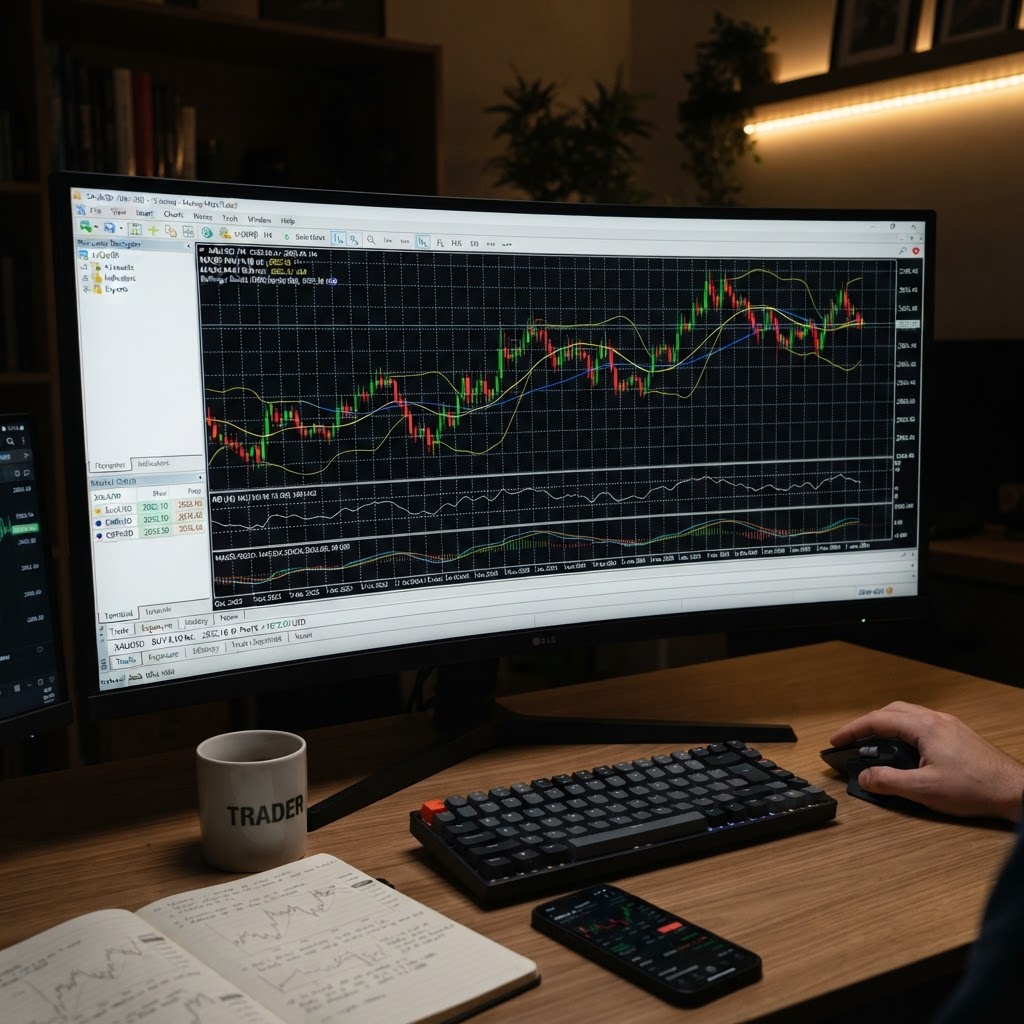
MetaTrader 5 . where I tried to automate forex
This is the story of how I temporarily abandoned a growing affiliate business to chase automated trading, and what it cost me.
Behind Appeal of Automated Money
Here's the honest truth: affiliate marketing is slow. You write content, you build links, you wait for Google to crawl, you wait for rankings, you wait for clicks, you wait for conversions. The feedback loop is weeks, sometimes months. I was making money, but it felt like watching paint dry.
Trading, on the other hand, was instant. You place a trade and within minutes you know if you made or lost money. The feedback loop is seconds. After months of writing blog posts that might not rank for six months, the idea of a system that could generate returns today was intoxicating.
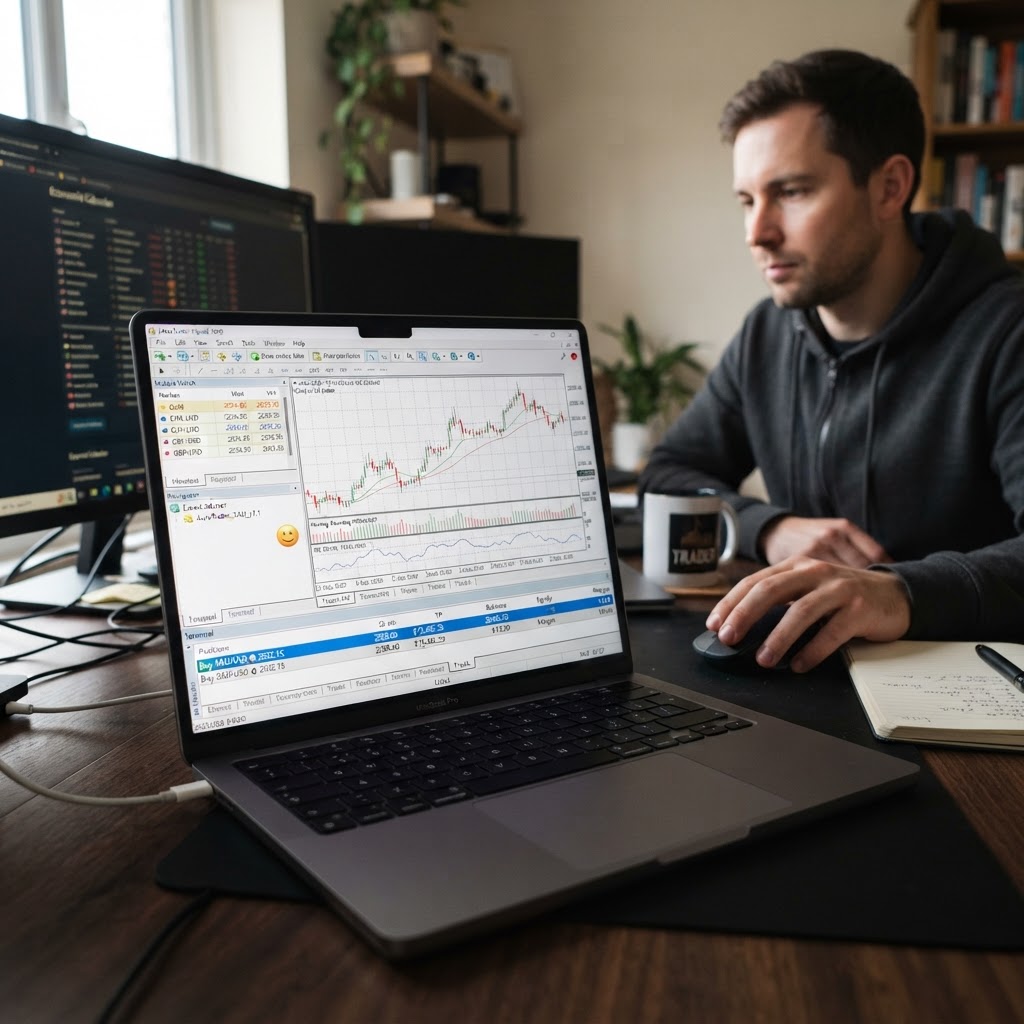
I'd been trading manually on Exness, using MT5 on my laptop. I was doing okay ( not great, but okay. I'd studied the charts, learned about RSI, MACD, support and resistance. But the problem with manual trading is that it requires you to be present. The gold market moves while Johannesburg sleeps. The best setups happen at 2 AM, 3 AM, 4 AM : the hours I was already sacrificing to the affiliate business.
A trading bot could solve that. It could watch the charts 24 hours a day, enter trades based on technical indicators, and manage risk automatically. I could literally make money in my sleep. Or so I thought.How Deep Diveh2>
I spent two weeks learning MQL5, the programming language for MetaTrader 5 Expert Advisors. I'm not a programmer. I don't have a computer science background. But I was determined. I watched tutorials, read documentation, studied other people's code. I built and tested and rebuilt.
GoldTrader v3 was my third iteration. The first version was too aggressive , it would open trades on every signal and blow through the account balance in a day. The second version was too conservative . it would hold positions for hours without entering a trade. The third version was supposed to be the Goldilocks version. Balanced risk-reward. Proper stop losses. Sensible position sizing.
I ran it on a demo account for three weeks. The results were... fine. Not spectacular, but consistent. Small gains, small losses, net positive at the end of each week. I was excited. This was going to work.My Reality Checkh2>
I switched to a live account with real money. Two hundred dollars. I was going to be conservative. Let the bot trade with a small amount, prove the concept, then scale up.
The first week, it made twelve dollars. The second week, it lost eight. The third week, it made five. The fourth week, it lost twenty-two. The pattern was clear: the bot was making less than minimum wage and doing it with significantly more stress.
But the bigger cost wasn't the trading losses. It was the opportunity cost. While I was obsessing over pip spreads and stop-loss levels, I wasn't writing blog posts. I wasn't creating YouTube videos. I wasn't building the affiliate pipeline. For two months, the content machine that was supposed to be my primary income source ground to a halt.
My affiliate revenue didn't drop to zero — the existing content was still ranking and converting. But it plateaued. The growth curve flattened. I was so focused on a trading bot making five dollars a week that I forgot about the affiliate business that was making fifty dollars a month and had the potential to make five hundred.
When Bybit Closed the Door
I also tried crypto trading on Bybit, because forex trading hours are limited and crypto trades 24/7. I thought I'd found the perfect solution: a market that never sleeps and a bot that never stops. But Bybit had other ideas. The platform restricted access from my region. I could log in, but I couldn't place trades. The API was blocked by IP restrictions.
I spent a week trying workarounds. VPNs, proxy servers, different account configurations. None of them worked reliably. And honestly, the fact that I was trying to circumvent regional restrictions should have been a sign that I was going down the wrong path.
Why Conversation That Brought Me Back
2>
What pulled me out of the trading rabbit hole wasn't a dramatic loss or a blown account. It was a simple realization: I had built a Fiverr gig for installing MT5 Expert Advisors. I was helping other people set up the same bots I was using. And I was getting better feedback from Fiverr clients than I was from my own trading.
The Fiverr gig was making me more money than the trading bot. A gig that took me twenty minutes to complete was paying more than a week of automated trading. That's when I understood something important about leverage: the skill of building and configuring trading bots was more valuable than the trading itself.
I Thing About It
2>
The trading detour wasn't a total waste. I learned MQL5, which became the foundation for my Fiverr gig. I learned about risk management, which applies to business decisions too. I learned that automated systems need monitoring, which is a lesson that transferred directly to my affiliate automations.
But most importantly, I learned that distraction looks like opportunity. The trading bot felt like it could accelerate my income. In reality, it was slowing me down. The affiliate business had momentum, and I took my foot off the gas to chase something that promised faster results.
I didn't stop trading entirely. I still run GoldTrader v3 on a small account with money I can afford to lose. But it's a side project now, not the main event. The main event is building content, building an audience, and building affiliate revenue that compounds over time.
The trading bot taught me that there are no shortcuts. There's only the work in front of you and the work that looks more exciting. Choose the work in front of you. It's almost always the better bet.
Setting Up MetaTrader 5 and Backtesting XAUUSD
When I decided to explore automated forex trading, I approached it with the same technical curiosity I used for web development. I downloaded MetaTrader 5 (MT5) build 3800 onto my Lenovo laptop and spent three days downloading 99% tick data for Gold (XAUUSD) spanning from 2021 to 2023. The Expert Advisor I bought was called GoldTrader v3, which cost me R1,200 from a seller on a Telegram trading group. I opened the strategy tester window and spent hours testing different parameter combinations: lot sizes set to 0.01 micro-lots, maximum spread filter at 25 points, target take profit at 40 pips, and a stop loss threshold at 20 pips. The backtest equity curves looked like a smooth stair-step upward to infinity, which gave me a dangerous surge of overconfidence.
To run an MT5 trading bot 24/7 without keeping my laptop turned on and consuming home electricity, I needed a virtual private server (VPS). I signed up with a Forex VPS provider operating out of the London Equinix LD4 data center to ensure sub-5ms trade execution latency to broker servers. The monthly VPS subscription cost $15 (approximately R275 per month), which was automatically debited from my Capitec card on the 1st of every month. Next, I opened a live Cent trading account with an offshore broker (Exness) and deposited R2,500 ($135) from my savings. Converting R2,500 into 13,500 US Cents allowed the Expert Advisor to execute micro-lots with enough margin buffer to survive minor drawdowns without blowing the account on day one.
Watching the first live automated trade execute was surreal. I was sitting at a local takeaway spot in Melville eating a boerewors roll when my phone buzzed with an MT5 push notification: 'BUY 0.01 XAUUSD at 1942.50 executed.' Five minutes later, another alert popped up: 'Order closed TP +$3.40.' I hadn't touched a keyboard, written a word of code, or spoken to a customer. It felt like I had unlocked a secret cheat code to automated wealth. But as any experienced trader will tell you, early beginner's luck with automated trading bots is the most expensive thing that can ever happen to a beginner.
The Anxiety of Live Execution and News Volatility
The honeymoon phase lasted exactly eleven days. What the backtests never prepared me for was the psychological weight of live market execution during high-impact macroeconomic news releases. Every month, the US Bureau of Labor Statistics releases the Non-Farm Payrolls (NFP) and Consumer Price Index (CPI) numbers at 14:30 SAST (South African Standard Time). On those afternoons, the gold market turns into an unpredictable rollercoaster, jumping 150 to 200 pips within seconds.
I remember one specific Tuesday afternoon while riding in a crowded minibus taxi along the N1 highway toward Sandton. It was 14:28 SAST, two minutes before the US CPI release. I had my phone out, staring anxiously at the MT5 terminal app. At 14:30, the inflation numbers came in lower than expected. Gold spiked violently upward, then reversed and crashed 180 pips in under ten seconds. The GoldTrader v3 bot, which used a hidden martingale grid recovery algorithm, opened four consecutive buy orders into the falling market to average down the position entry price. My floating drawdown shot from -$5 to -$45, then -$85—wiping out over R1,500 of equity in 45 seconds.
My heart was pounding in my chest while sitting crammed in the back row of that taxi. Sweat was pouring down my forehead as I watched my hard-earned savings evaporate in real time. The panic became unbearable, and at -$92 floating loss, I manually overrode the bot and closed all open positions at a massive loss. Five minutes later, the market stabilized and retraced back upward—meaning if I had left the bot alone for another three minutes, it would have closed in profit. But the sheer emotional stress proved that I wasn't running a passive system; the system was running me.
The Hidden Costs: Spreads, Slippage, and Overnight Swaps
As the weeks went on, I uncovered the glaring discrepancies between simulated backtesting results and real-world live trading execution in South Africa. The first hidden killer was spread widening. Every night at 23:00 SAST, during the transition between the New York close and the Asian market open, liquidity drops globally. Forex brokers widen their bid-ask spreads dramatically—Gold spreads would blow out from 15 pips to 85 pips for about thirty minutes. The bot, unaware of the spread spike, would trigger pending orders at terrible prices, instantly putting positions in negative territory before the trade even started.
The second hidden cost was overnight swap fees. Holding gold positions open overnight incurs financing interest charges from the broker. If a grid position stayed open for three days waiting for a price pull-back, the daily swap charges ate up 40% of the prospective take-profit margin. Billed in USD, these micro-deductions continuously eroded my Capitec bank account balance. Add to that the R275 monthly VPS hosting fee and the R1,200 initial cost of the EA software, and the financial baseline was heavily tilted against profitability.
More than the monetary loss, the biggest cost was time and mental focus. I was spending four to five hours every evening tweaking MT5 parameter inputs, analyzing MQL5 source code logs, reading forex forum threads on Forexfactory, and monitoring Telegram signal channels. That was time I should have been spending writing high-ranking SEO content for vitaladge.com or recording video tutorials for my YouTube channel. I was neglecting my core digital assets—which were zero-risk and high-margin—to gamble on high-risk financial algorithms.
Opportunity Cost and Returning to Core Digital Assets
After eight exhausting weeks of monitoring MT5 charts, I sat down on a Sunday morning to conduct an honest financial audit of my trading bot experiment. The numbers were stark and undeniable: I had started with R2,500, spent R550 on two months of VPS hosting, paid R1,200 for the EA software, and had a remaining account balance of R1,530. My net financial loss on the experiment was R1,720—money that could have paid for 14 months of web hosting or months of high-speed Vodacom data bundles.
Even worse was the opportunity cost. During those two months of distraction, organic traffic to vitaladge.com had plateaued because I hadn't published new content. My YouTube channel upload schedule had slipped from two videos a week to zero. I had traded a predictable, compoundable digital publishing business for a stressful, volatile financial derivative game where I had zero competitive advantage.
That Sunday afternoon, I logged into my VPS dashboard and clicked 'Stop EA'. I closed the MT5 application, initiated a full withdrawal of my remaining R1,530 from Exness back to my Capitec bank account, and canceled the VPS recurring subscription. It was a humbling lesson, but an essential one. Automated trading bots were not a shortcut to passive income; they were a high-maintenance detour. I closed the trading software for good and opened WordPress and Google Docs to get back to the real work of building genuine, long-term digital business assets.



Comments
Post a Comment