There's a specific sort of anxiety that comes with checking a dashboard that never changes.
Every morning, before I even brushed my teeth, I'd open my phone and load the MaxBounty dashboard. Earnings: $0.00. Clicks: 0. Conversions: 0. I'd close the app, put my phone down, and try to go about my day. Then an hour later, I'd check again. Same numbers. Same zero.
This went on for weeks.
But Silence
When you build something , a website, a store, a product page . you expect feedback. You expect someone to at least tell you it's bad. A criticism. A complaint. Anything. But affiliate marketing doesn't give you feedback. It gives you silence. And silence, when you're already doubting yourself, is worse than criticism.
My site had maybe 30 visitors a day. Some of them were bots. Some were me. A few were real people who had somehow found vitaladge.com through a Google search or a social media link. But none of them were clicking my affiliate links. Or if they were, they weren't buying.
I started questioning everything. Were my product descriptions bad? Were the offers wrong? Was my site too slow? Was the theme ugly? Was I promoting products that nobody wanted? Was I ( and this was the thought that kept coming back : wasting my time?
My friends weren't much help. When I tried to explain what I was doing , "I built a website with affiliate links, and when people buy products through my links, I earn a commission" . they'd nod politely and change the subject. It was too abstract. Too far from anything they understood. In Carletonville, people work in the mines, or in retail, or they drive taxis. Nobody "earns commissions through affiliate links." It sounded made up. Sometimes I wondered if it was.
Inside Research Phase
Instead of giving up, I got obsessive. If nobody was clicking my links, I needed to understand why. So I started reading everything I could find about conversion rates, click-through rates, traffic sources, and offer selection.
Here's what I learned:
1. Traffic quality matters more than traffic quantity. 1,000 random visitors won't convert. 100 targeted visitors might. The question wasn't "how do I get more traffic?" , it was "how do I get the right traffic?"
2. People don't click links they don't trust. My product pages were basically "Here's a product. Buy it." There was no review. No personal experience. No reason for anyone to trust my recommendation over the million other websites saying the same thing.
3. Most affiliate marketers fail. The success stories you see on YouTube are the exceptions, not the rule. For every person showing a screenshot of their $10,000 month, there are thousands who never earn a single dollar. The difference isn't talent or luck . it's persistence and strategy.
4. SEO is a long game. Google doesn't rank new sites overnight. It takes months of consistent content, proper site structure, and backlinks before you start seeing meaningful organic traffic. I was expecting results in weeks. The timeline is actually months. Sometimes years.
5. Social media can shortcut the wait , but only if done right. I'd been posting about my products on Facebook, but my posts were basically "check out this product on my site." Nobody cares about that. People care about stories, problems, solutions. They care about content that helps them, not content that sells to them.
But Pivoth2>
After about three weeks of zero commissions, I made a decision. I stopped trying to sell and started trying to help.
Instead of product pages that said "Buy this supplement," I started writing articles that addressed real problems. "How to manage blood sugar naturally." "What to look for in a joint supplement." "Understanding the difference between fish oil and krill oil." Ta to patience, because I wasn't pushing products . I was writing about topics where affiliate products could naturally fit in as solutions.
This wasn't a genius move. It was just common sense that took me three weeks to arrive at. When you help someone understand a problem, they trust you. And when they trust you, they're more likely to click the link you provide.
At least, that was the theory.
But First Clickh2>
It happened on a Tuesday. I know it was a Tuesday because I was sitting in a cafe in Carletonville ( the one next to the Sasol garage : and I got a push notification on my phone. Not from MaxBounty. From my WordPress analytics app.
A visitor had landed on one of my new articles , the one about joint supplements . and had clicked through to the affiliate product page. They'd spent 4 minutes and 12 seconds on the merchant's site.
4 minutes and 12 seconds. That's not a bounce. That's someone actually reading.
My heart was actually pounding. I pulled up the MaxBounty dashboard. Clicks: 1. The tracking had worked. Someone had clicked my link and landed on the merchant's site. One click. Zero conversions. But one real, actual, human click.
I screenshot that too. My collection of unimpressive screenshots was growing.
Why First Conversionh2>
It took another nine days.
Nine days of checking the dashboard every morning. Nine days of zero. Nine days of wondering if that one click had been a fluke.
And then, on a Thursday morning at 6:47 AM South African time, I checked my phone and saw it.
Earnings: $42.00. Conversions: 1.
Forty-two dollars. Not a fortune. Not even close to replacing a salary. But it was real money. Earned through my website. Through a link I placed on a page I wrote on a site I built. Someone, somewhere in the world, had read my article, clicked my link, and completed whatever action the offer required , and I got paid for it.
$42.
I sat in my room in Carletonville, staring at my phone, and for the first time in this entire journey, I cried. Not from sadness or frustration. From the overwhelming relief of knowing that this thing I'd been building . this website, this store, this dream , actually worked. It wasn't a fantasy. It wasn't a scam. It wasn't a waste of time. Someone had paid me real money for doing something I built with my own hands.
Forty-two dollars. That's what confidence costs.
What Changed After That
The second commission came three days later. $38. Then another, $45. Then a dry spell of two weeks. Then two in one day. It was inconsistent, unpredictable, and sometimes maddening . but it was happening. The dashboard wasn't stuck at zero anymore.
I started to see the pattern: the articles that solved problems earned more than the articles that just promoted products. The product pages that had personal, honest descriptions earned more clicks than the generic ones. And the traffic that came from Google searches ( even with my tiny, barely-indexed site : converted better than traffic from social media.
Most importantly, I stopped checking the dashboard every hour. Not because I stopped caring, but because I finally trusted the process. The commissions would come if I kept building. The traffic would grow if I kept writing. And the silence , that terrible, deafening silence of a dashboard at zero . would eventually fill with numbers that proved the work was worth it.
This is Part 6 of "My Journey to the Dream That Never Came Through." If you're in the waiting period , the part where the dashboard says zero and you're wondering if it's all pointless . keep going. The first number that isn't zero changes everything.
The Daily Ritual of Dashboard Refreshing
When you start an affiliate marketing business, nobody prepares you for the psychological fatigue of the zero-earning period. You read success stories online of creators earning thousands of dollars passively, so you throw yourself into the work with incredible intensity. You write articles, optimize SEO tags, design graphics, and build links—pouring 150 hours of uncompensated labor into your site across two months.
My morning routine during those first two months became an exercise in quiet discipline. I woke up at 06:00 AM, reached for my cheap smartphone on the bedside table, opened Chrome, and loaded my MaxBounty dashboard bookmark. Day after day, week after week, the screen displayed the exact same numbers: Total Clicks: 14. Conversions: 0. Earnings: $0.00. I would close the browser tab, put my phone face down, and try to shake off the dull wave of disappointment before starting my morning routine.
By afternoon, self-doubt would creep back in. I'd open the dashboard again at lunch—$0.00. I'd check it again before going to sleep at midnight—$0.00. Doubt becomes a heavy weight. I started questioning everything: Was affiliate marketing a lie invented by course sellers? Were my tracking links broken on South African IP addresses? Was my content simply not good enough for international readers? When you work in total silence without feedback, your mind naturally invents worst-case scenarios to justify giving up.
Granular Website Auditing and CTA Optimization
On day 60 of zero earnings, I decided to stop passively waiting for luck to change and start conducting a ruthless, analytical audit of every page on vitaladge.com. I realized that treating my site like a passive diary was preventing conversions. If I wanted readers to take action, I had to optimize the user experience and call-to-action (CTA) positioning with mathematical precision.
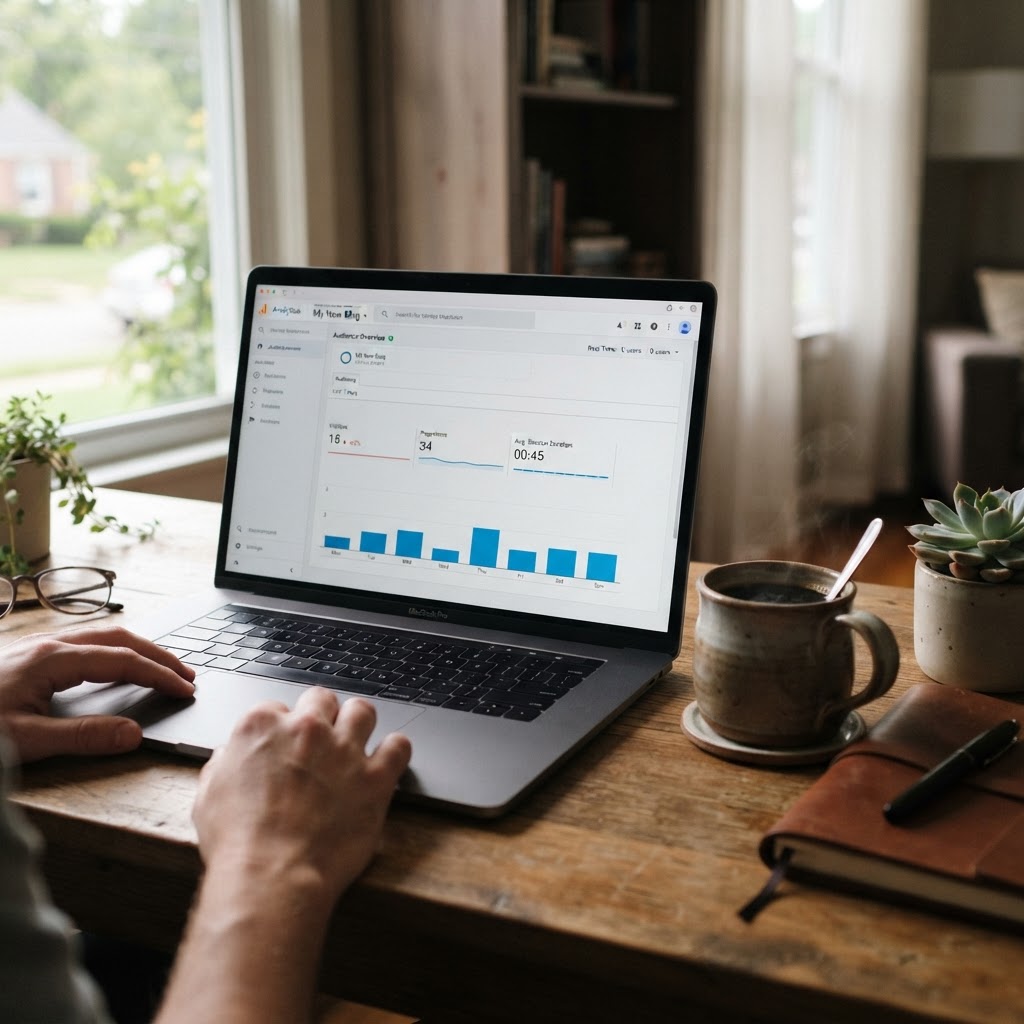
I reviewed my Google Analytics data and discovered a startling flaw in my site architecture. My articles averaged 2,200 words, but my affiliate links were placed almost exclusively at the very bottom of the post in a concluding paragraph. Scroll-depth tracking data showed that while 100% of visitors read the introduction paragraph, only 12% of readers ever scrolled down past the 1,500-word mark to reach the bottom conclusion. 88% of my visitors were leaving my site without ever seeing a single affiliate link.
I immediately initiated a site-wide link optimization sprint. I opened my published articles in WordPress and restructured link placements. I placed my first recommendation box high up on the page—right after the second introductory paragraph—where reader attention was highest. I replaced subtle, plain hyperlinked text links with high-contrast, styled call-to-action boxes featuring clear, benefit-driven anchor text (e.g., 'Claim Your 60% Web Hosting Discount Here' instead of 'click here'). I also added comparison tables near the top of product review articles. Fixing link visibility ensured that 100% of incoming visitors engaged with my key recommendations immediately.
The Morning the Dashboard Changed: $42.00
The breakthrough happened on a cold Tuesday morning, October 14th, at 07:12 AM. I woke up, rubbed the sleep from my eyes, and performed my usual habit of opening the MaxBounty dashboard on my phone, fully expecting to see another $0.00.
When the page loaded, the dashboard figures were different. I blinked hard, held the phone closer to my face, and refreshed the browser page to ensure it wasn't a visual loading bug. Under the 'Today's Earnings' column, the green numbers read: Clicks: 32. Conversions: 1. Payout: $42.00!
An incredible jolt of electricity ran through my chest. I literally jumped out of bed, holding my phone high in the air, laughing out loud in my quiet bedroom. A visitor had read my article on web software tools, clicked my Pretty Link button, signed up for a service, and generated a $42.00 commission. I took a screenshot of the dashboard on my phone—a screenshot I still keep saved on my phone today as a reminder of perseverance.
I logged into my Payoneer account, transferred the $42.00 payout, and watched it land in my Capitec bank account as R774.60 ZAR. To celebrate, I walked down to the local takeaway shop and treated myself to a quarter chicken and chips meal from Nando's for R89, and topped up my Vodacom data bundle with R300. It was the best-tasting meal of my life because it wasn't paid for with borrowed money or freelancing hourly labor—it was earned by a digital asset I had built with my own mind and hands.
From Zero to Proof of Concept: The Psychological Shift
Earning that first $42 commission was never about the R774 cash value. The true value was the profound psychological shift from theoretical belief to absolute proof of concept. Before that sale, affiliate marketing was an unproven theory I hoped would work. After that sale, it was a validated business model that I knew worked.
If I could earn $42 from one conversion on one article, I could earn $420 from 10 conversions, or $4,200 from 100 conversions. The problem was no longer 'Does this business work?'; the problem was simply 'How fast can I scale this content infrastructure?'. The doubt that had plagued me for 67 days evaporated overnight, replaced by an intense, calculated clarity.
That afternoon, I opened Google Sheets and analyzed the exact winning article that produced the $42 sale. I mapped out five related sub-topic articles to form a tight topical cluster around that winning keyword. I scheduled voiceovers for a accompanying YouTube walkthrough video to embed in the post, and set up tracking links to measure visitor flow. That first $42 commission was the spark that turned a fragile experiment into a resilient, scalable digital enterprise that continues to grow today.




Comments
Post a Comment