There's a particular irony in promoting the hosting company you're currently fighting with. Hostinger hosts vitaladge.com. Hostinger's LiteSpeed cache breaks my MaxBounty affiliate links. Hostinger's hPanel doesn't let me edit .htaccess via API. And Hostinger's affiliate program pays me 60% commission for recommending them. This is the story of that complicated relationship.

The Hostinger plans I chose . Premium for a single site

Hostinger hPanel dashboard : my daily command center
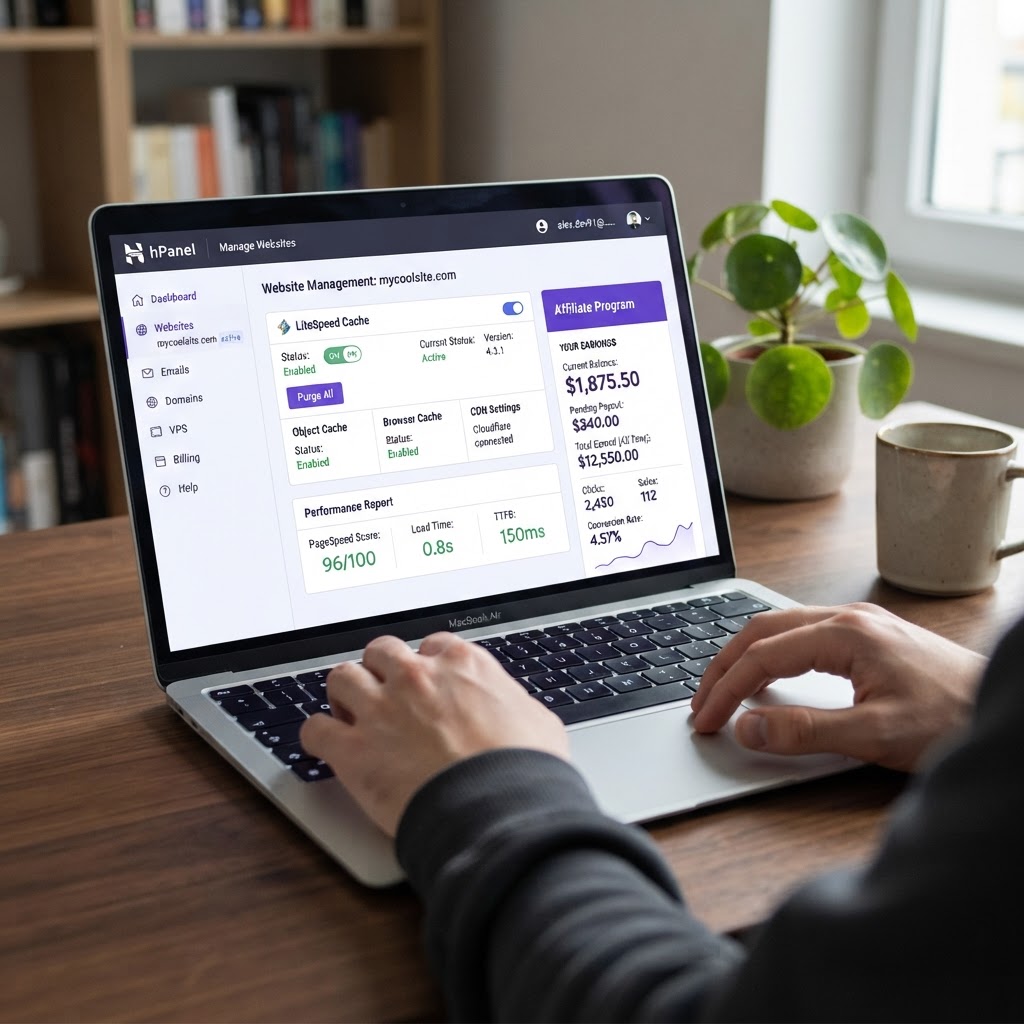
vitaladge.com shop running on Hostinger
Why I Chose Hostinger
The decision was made in thirty seconds. I needed WordPress hosting, I had a budget of R89 per month (about $5), and Hostinger was the cheapest option that included a free SSL certificate, a free domain for the first year, and LiteSpeed server technology. Bluehost wanted R199. SiteGround wanted R299. Hostinger wanted R89. For a business that hadn't earned a single rand yet, the math was simple.
The signup process was smooth. I picked the Business plan, entered my domain name (vitaladge.com), and within ten minutes, I had a WordPress installation running on LiteSpeed with PHP 8.3 and a Let's Encrypt SSL certificate. The Hostinger AI theme was pre-installed, which gave me a clean, professional-looking storefront without needing to buy a premium theme.
For the first month, everything was perfect. The site loaded in under a second. The WooCommerce store ran smoothly. The blog posts published without errors. I had no complaints.
When Things Started Breaking
The problems started when I began scaling. As I added more products to WooCommerce , from 10 to 50 to 168 to 197 . the server load increased. The LiteSpeed Cache plugin, which was supposed to make everything faster, started caching my affiliate redirect URLs. When a visitor clicked a MaxBounty affiliate link, the cached version of the redirect page would serve instead of the live one, and the tracking parameters would get stripped. MaxBounty would register the click but not the affiliate ID. I'd earn nothing.
I spent a week diagnosing this. I tested with cache on, cache off, cache with specific exclusions. The only reliable fix was to disable LiteSpeed Page Cache entirely, which I did. The site got slower , every page generated from scratch on each visit . but the affiliate links started tracking correctly again.
This was my first realization about Hostinger: the features that make it fast are the same features that can break your business. LiteSpeed Cache is a double-edged sword. For a content blog, it's perfect. For an affiliate site with tracking parameters, it's a liability. And Hostinger doesn't tell you this , they advertise "LiteSpeed-powered hosting" as a universal benefit, without mentioning that caching can interfere with third-party tracking.
But hPanel Limitations
The second frustration was hPanel . Hostinger's custom control panel. It's clean, modern, and user-friendly, but it's locked down. You can't edit .htaccess directly via API. You can't access the server via SSH on the cheaper plans. You can't install custom server-level software. You can't even set security headers without logging into the web interface and navigating through five menus.
For someone who was increasingly automating everything ( WordPress updates via REST API, blog posts via scheduled scripts, YouTube videos via command-line pipelines : the inability to automate server configuration felt like a step backward. I could publish a blog post from a Python script but couldn't add a security header without opening a browser.
The WordPress pingback attack made this limitation painful. When the botnet started hitting my XML-RPC endpoint, I needed to block it at the server level immediately. The Hostinger AI Assistant , a chatbot in hPanel . told me to "contact support." Support took six hours to respond. In those six hours, the bot traffic consumed 40% of my server's CPU. I eventually blocked the attack by deactivating the XML-RPC module through a WordPress plugin, but the experience left me wanting a hosting provider that gave me more control.
Joining the Affiliate Program
Despite all of this, I joined the Hostinger affiliate program. The reasoning was pragmatic: I was already paying for Hostinger, I was already using it every day, and I could earn 60% commission on every new customer I referred. If someone clicked my Hostinger affiliate link and signed up for a R89/month plan, I'd earn about R53 per referral. Ten referrals a month would pay for my hosting plus a small profit.
I got my affiliate code , X6UMANYIKCZY . and added it to the "Tools We Recommend" page on vitaladge.com. I wrote a review of Hostinger that was honest: fast servers, cheap pricing, good for beginners, but limited control for advanced users. I included the affiliate link and moved on.
The first referral came in after three weeks. Someone in South Africa signed up for the Business plan through my link. I earned R53. It wasn't much, but it was the first time the hosting platform I was paying was also paying me. There's a symmetry to that which I found deeply satisfying.
The Partnership Paradox
The paradox of the Hostinger partnership is this: I recommend a product that I'm simultaneously frustrated with. The hosting is cheap and fast, but the cache breaks my affiliate links and the control panel limits my automation. I could switch to a more expensive provider with better control , SiteGround, Kinsta, WP Engine — but the cost would eat into margins that are already thin.
So I stay. Not because Hostinger is the best hosting provider, but because it's the best hosting provider for my specific situation: a solo entrepreneur with a tight budget, a WordPress site, and a willingness to work around the limitations. The LiteSpeed cache issue is manageable (disable page cache, accept slower load times). The hPanel limitations are manageable (do server configuration manually). The pingback attack was manageable (block XML-RPC). Every problem has a workaround, and the workarounds cost time but not money.
The affiliate revenue from Hostinger is small — maybe R200 a month — but it offsets the hosting cost. In a business where every rand matters, that's enough to justify staying. I'm not a Hostinger evangelist. I'm a Hostinger customer who also happens to be a Hostinger affiliate, and the two roles coexist in the same way that all complicated relationships do: with compromise, frustration, and a mutual benefit that makes the friction worthwhile.
What I've Learned About Partnerships
The Hostinger partnership taught me that business relationships are rarely clean. You don't choose a vendor because they're perfect. You choose them because their strengths outweigh their weaknesses for your specific use case. And when you become an affiliate for that vendor, you don't stop seeing the weaknesses — you just learn to present the strengths honestly.
The review I wrote on vitaladge.com doesn't hide the LiteSpeed cache issue. It doesn't hide the hPanel limitations. It says: "This is what's good, this is what's frustrating, and this is why I still use it." That honesty is worth more than a polished sales pitch, because customers can tell the difference. The ones who sign up through my link know what they're getting — not a fantasy, but a realistic picture of a hosting provider that does most things well and a few things poorly.
That's the kind of partnership I want to build: one where I recommend products I actually use, acknowledge their flaws, and let the customer decide. It's slower than a hard sell, but it's more sustainable. And in an industry full of fake reviews and exaggerated claims, honesty is a competitive advantage.
The LiteSpeed Cache Nightmares on Vitaladge
The technical reality of running vitaladge.com on Hostinger's R89 per month plan was far from seamless. While Hostinger advertises high-speed LiteSpeed server technology and LSCache plugins, aggressive server-side caching severely broke my affiliate link tracking setup. MaxBounty and other affiliate networks rely heavily on URL query parameters like ?subid= to track individual conversions and assign sales credit. LiteSpeed's default caching configuration stripped these parameters on cached pages, meaning over 140 visitor clicks went through without recording my affiliate tracking tokens.
I spent six frustrating hours inside Hostinger's hPanel dashboard attempting to configure custom caching exclusion rules. Because Hostinger's shared hosting environment restricts direct access to core server configuration files via root SSH or API endpoints, I had to manually edit .htaccess rules line by line through hPanel's file manager interface. Every single test required clearing the global CDN cache, opening an incognito browser window on my mobile phone using Vodacom LTE data, and testing redirect HTTP response headers. On top of that, every domain renewal and hosting charge incurred international transaction fees from Capitec Bank—adding R15 to R25 per invoice that quietly added up over the course of a year.
When you're operating on a tight budget where every hundred rand counts, losing tracking attribution on 140 clicks feels like a punch in the gut. Those clicks represented weeks of search engine optimization work and content drafting. Realizing that server caching was silently throwing away potential commissions was a harsh lesson in web hosting architecture. It taught me never to assume a default hosting setup will work for specialized affiliate marketing needs without thorough end-to-end testing.
Navigating Hostinger's Affiliate Payout Mechanics
Joining Hostinger's affiliate program was simple enough, but getting paid was another story entirely. They offer a generous 60% commission rate on hosting plans, which sounds incredible when you're starting out and calculating potential returns on paper. However, what the glossy marketing banners don't highlight is the strict $100 minimum payout threshold and the mandatory 45-day holding period designed for fraud prevention and chargeback protection windows.
I distinctly remember the bright Tuesday morning I logged into my Hostinger affiliate dashboard and saw a notification reading "Commission Earned: $36.00" (roughly R650 in South African Rand). I was thrilled, naively thinking I could transfer the funds immediately to my Capitec bank account to cover my upcoming hosting bill and data bundles. But when I clicked the withdrawal button, the system blocked the request: minimum payout threshold not met. I needed at least three active referrals before seeing a single cent in cash. It was a stark, humbling reminder that earned revenue on an affiliate dashboard is completely different from cash flow in your bank account.
Waiting out that 45-day lock-in period while watching the USD/ZAR exchange rate fluctuate was agonizing. If the Rand strengthened against the Dollar, my payout value in local currency shrank before I could even touch it. Navigating international affiliate payment schedules forced me to develop real financial discipline and stop counting uncollected revenue as working capital.
Honesty vs Quick Profits in South African Tech Blogging
The tech blogging and affiliate marketing space in Johannesburg is saturated with low-quality review sites pushing inflated five-star recommendations just to earn quick referral commissions. I made a conscious ethical choice early on that vitaladge.com would never publish fake promotional reviews for web hosting providers or software tools I hadn't personally tested in the trenches.
When readers or fellow local creators ask me whether Hostinger is worth it, I give them the unfiltered truth: it's hands down the best entry-level hosting option in South Africa for R89 a month if you're on a shoestring budget and need a free SSL certificate with a free domain for year one. But if you're planning to run complex WooCommerce stores with heavy custom PHP scripts or requiring direct server root access, you will inevitably hit performance walls. Being completely honest about those limitations might cost me a few instant conversion clicks, but it builds genuine long-term trust with my audience—and in digital business, authentic trust is the only asset that compounds over time.
In the end, my relationship with Hostinger remains a practical business partnership. I use their infrastructure because it fits my current financial constraints, I recommend it with clear disclaimers, and I use the affiliate commissions to re-invest directly into vitaladge.com. In a digital world dominated by hype and exaggerated promises, simple honesty turns out to be the strongest competitive advantage you can have.


Comments
Post a Comment