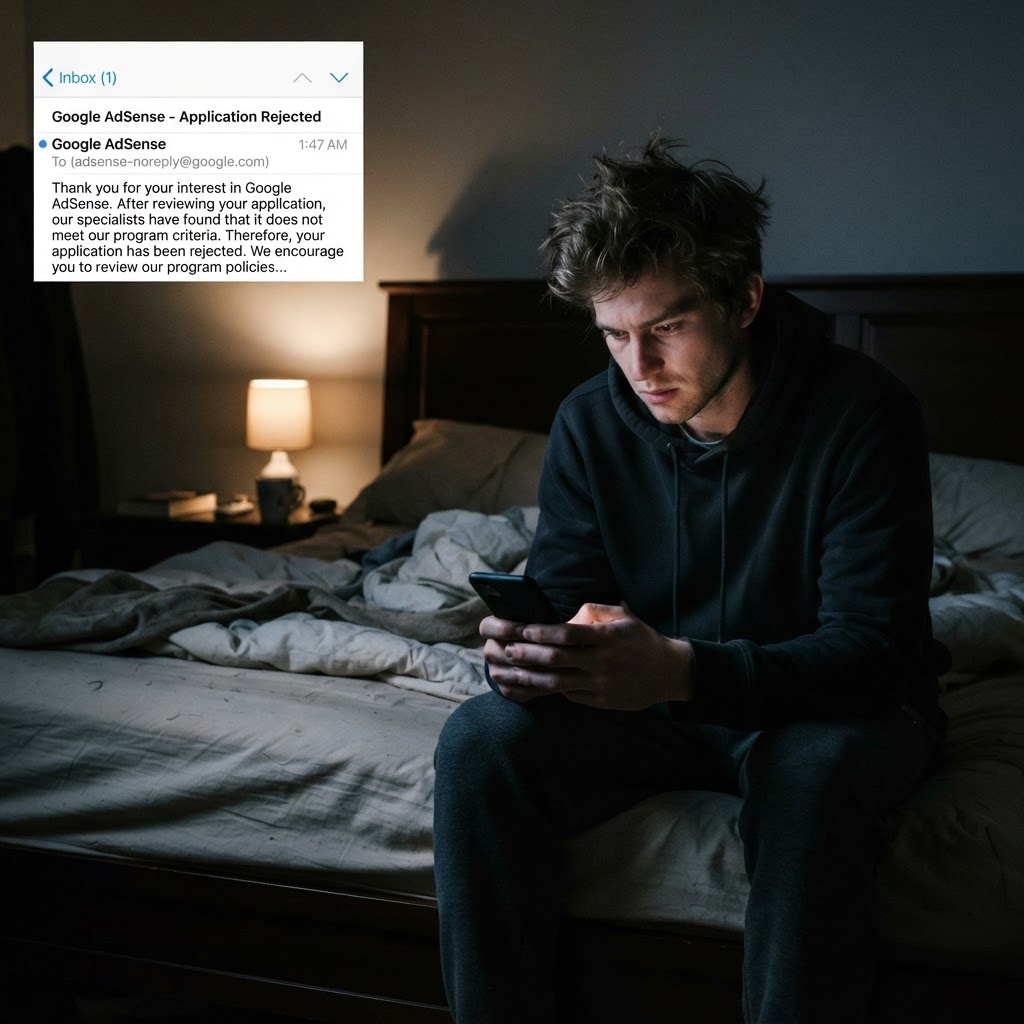
I remember exactly where I was when I got the first rejection. Sitting on the edge of my bed, phone in hand, refreshing my email. It was late , past eleven . and I should have been sleeping. But I'd applied for Google AdSense three days earlier and I was checking for a response the way you check for exam results. Anxious. Hopeful. Preparing myself for either outcome and failing at both.
The email arrived at 10:47 PM. The subject line was clinical: "Your AdSense application status." I opened it. Read the first line. Read it again. Then I put my phone down and stared at the wall.
Rejected.
The Email
Google AdSense rejections don't tell you exactly why you were rejected. They give you a list of possible reasons ( a menu of vagueness : and leave you to figure out which one applies to you. My email mentioned "insufficient content," "low value content," and "navigation issues." It was like being told your car won't start because of an engine problem, a battery problem, or possibly a tire problem. Helpful, but not really.
Here's what I know now that I didn't know then: my site at that point was barely a website. I had maybe fifteen blog posts, most of them short. The product pages were thin , just a title, a brief description, and an affiliate link. There was no About page, no Privacy Policy, no Contact page. The navigation was clunky. The design was whatever the default template gave me. I had applied because I'd heard people say "apply early, you can reapply," but I'd applied before I had anything worth showing Google.
I wasn't angry at Google. I was angry at myself. I'd rushed it. I'd been so eager to start making money that I'd submitted a site that wasn't ready. The rejection wasn't Google being unfair . it was Google being accurate. My site was thin, hard to navigate, and didn't offer enough value to justify showing ads to visitors. I knew it. Google knew it. The email was just the first time someone said it out loud.
What I Did Wrong
Honestly, looking at it now, I made three specific mistakes that guaranteed the rejection.
First, I applied too early. My site had been live for maybe three weeks. I had a handful of blog posts, most of which were under five hundred words. Google wants to see a site with depth , enough content to demonstrate that the site is a real resource, not just a landing page for affiliate links. I had maybe twenty pages total. Most established sites that get approved have at least thirty to fifty quality posts.
Second, my content was thin. The blog posts I had were more like product descriptions than articles. They didn't answer questions, didn't provide value, didn't give a reader a reason to stay. They existed to host affiliate links, and Google could tell. AdSense's content policies specifically mention "low value content" . pages that exist primarily to drive traffic to ads or affiliate offers without providing genuine value. That was exactly what I'd built.
Third, I had no essential pages. No Privacy Policy. No About page. No Contact information. No Terms of Service. Google looks for these because they signal that a site is a real business, not a throwaway project. Their absence doesn't just look unprofessional , it's a red flag. A site without a Privacy Policy is a site that hasn't thought about user data, and Google takes user data very seriously.
The 24 Hours After
I didn't touch the site for a day. Not because I was giving up . I was embarrassed. I'd told a few friends about the site, about the plan to monetize with AdSense. Now I had to admit that Google had looked at it and said no. It felt like a report card with a failing grade.
But after a day of sulking, I went back to the email and read it more carefully. Google didn't say "never." They said "not yet." The email mentioned that I could reapply after addressing the issues. It wasn't a door closing ( it was a door being pointed out that I hadn't opened yet.
So I made a list. Write more content. Longer posts. Better quality. Add the essential pages. Fix the navigation. Make the site look like a real resource, not a link farm. It was a checklist, and Google had handed it to me for free.
I started working through it that same night. Wrote a Privacy Policy. Created an About page. Added a Contact form. Wrote two new blog posts that were actual articles : not product descriptions, but genuine posts about health topics that people might search for. Each one was over a thousand words. Each one answered a real question.
It felt like starting over. But it was actually starting properly for the first time.
, Justice
What the Email Actually Said
The email was polite. It was corporate. It was the kind of email that is designed to communicate rejection without making you feel like you've been rejected, which somehow makes it worse. The subject line said "Your AdSense Application . vitaladge.com" and the body said something about reviewing my site and determining that it did not currently meet their program policies.
It didn't say which policies. It didn't say what was wrong. It didn't say "your content is too short" or "your navigation is confusing" or "you only have three posts." It just said "does not meet our program policies" and linked to a help article that listed forty-seven possible reasons. Forty-seven. That's not guidance. That's a checklist designed to make you feel like you failed at everything simultaneously.
I read the email three times. The first time, I was looking for a specific reason. The second time, I was looking for an appeal process. The third time, I was just reading it because I couldn't believe it was real. I had spent two weeks preparing what I thought was a proper website. I had written three blog posts, each one carefully researched and edited. I had a clean theme, a proper navigation structure, and a privacy policy I had copied from a template and customized. I thought I was ready.
I was not ready.
The Three Posts Problem
Now that some time has passed, the problem was obvious. I had three posts. Three. Not thirty, not three hundred , three. And they weren't long posts either. Each one was about 600 words, which sounds reasonable until you realize that Google AdSense is looking for websites that demonstrate sustained content production. They want to see that you're committed to creating content over time, not that you threw together three posts in a weekend and called it a business.
The part that still gets me that I had read this advice before applying. Every YouTube video about AdSense approval said the same thing: "Have at least 20-30 posts before you apply." I watched those videos. I nodded along. And then I applied with three posts because I was gatvol with waiting, entlek, I was gatvol with the whole system and because I thought my content was good enough to be the exception.
It wasn't. Nobody's content is good enough to be the exception. Google doesn't care how well-written your three posts are. They care about volume, consistency, and the signal that you're going to keep producing content after they approve you. Three posts says "I might quit tomorrow." Thirty posts says "I'm probably going to keep going." Three hundred posts says "I'm not going anywhere."
What I Did Instead of Quitting
After the rejection, I had two choices. The first choice was to quit. To close the laptop, delete the website, and tell myself I tried. That would have been the reasonable thing to do. It would have saved me R79 a month in hosting costs and given me back the hours I was spending on something that wasn't working. The second choice was to keep going — to write more posts, to build more content, and to reapply when I had something that looked like a real website.
I chose to keep going, but not because I was brave. I chose to keep going because I had already told too many people about it. I had told Sipho, I had told my cousin Thabo, I had told a guy at work whose name I won't mention because he laughed the hardest. Quitting after telling everyone would have been worse than failing quietly. So I kept going, driven not by confidence but by the fear of looking like someone who gives up.
I set a target. I would write 20 posts before I reapplied. Not three. Twenty. And not 600-word posts — longer ones, with real research, with real opinions, with the kind of depth that says "I actually know what I'm talking about." I gave myself a month. It took me six weeks, because writing good content takes longer than you think, especially when you're working a full-time job and writing at night.
The Lesson I Didn't Learn Until Later
The rejection taught me something I wouldn't fully understand until much later: Google AdSense is not a gatekeeper. It's a mirror. When they reject your site, they're not saying your content is bad. They're saying your site doesn't look like a real business. And the difference between a real business and a hobby is not the quality of any single post — it's the volume, the consistency, and the infrastructure around the content.
Three posts on a clean website is a hobby. Three hundred posts on a clean website with proper categories, internal links, a privacy policy, a contact page, and an about section is a business. The content quality matters, but the infrastructure matters more. AdSense wants to see that you've built a system, not just a few articles.
This is why I started writing every day. Not because I enjoyed it — I didn't, not at first. Writing is hard. Staring at a blank page and trying to turn your thoughts into paragraphs that other people will read is one of the most vulnerable things you can do. But I did it because I understood, for the first time, that the path to AdSense approval wasn't about writing one perfect post. It was about writing enough posts that the imperfection of any single one didn't matter.
I would go on to collect more rejections before I was done. The second rejection would come after I had 30 posts, and it would say "insufficient content," which I found ironic given that I had ten times the content of my first application. The third rejection would cite "policy violations" without specifying which policies. Each rejection would feel personal, even though they weren't. Each one would make me question whether I was wasting my time, even though I knew I wasn't.
But the first rejection was the most important one. It was the one that taught me What separates "I think I'm ready" and "I'm actually ready" is never as small as you hope. And it was the one that made me stop looking for shortcuts and start doing the work.
I would later learn that AdSense rejection is not a final verdict. It's a checkpoint. The ones who make it website has been rejected at least once. The ones that made it through didn't have better content — they had more content. They had infrastructure. They had the kind of persistent, unglamorous work that doesn't show up in any single post but shows up everywhere when you look at the site as a whole.
Years later, when I talk to other creators about AdSense, I tell them this: the rejection email is not a verdict on of your writing. It's a judgment of your website's maturity. And maturity, in Google's eyes, comes from volume, consistency, and the patience to build something that looks like it will still exist in six months. Three posts don't say that. Forty-five posts do. Two hundred posts say it louder. The number matters more than the quality of any single piece, because Google isn't reading your best post — it's counting your total output and checking whether the infrastructure around it suggests commitment.
Related Journey Entries
That's the thing about building something from nothing — the first step always looks like a mistake until it isn't.





Comments
Post a Comment