Is Credo Mutwa's Prophecy Coming to Pass? What This Week in South Africa Made Me Ask
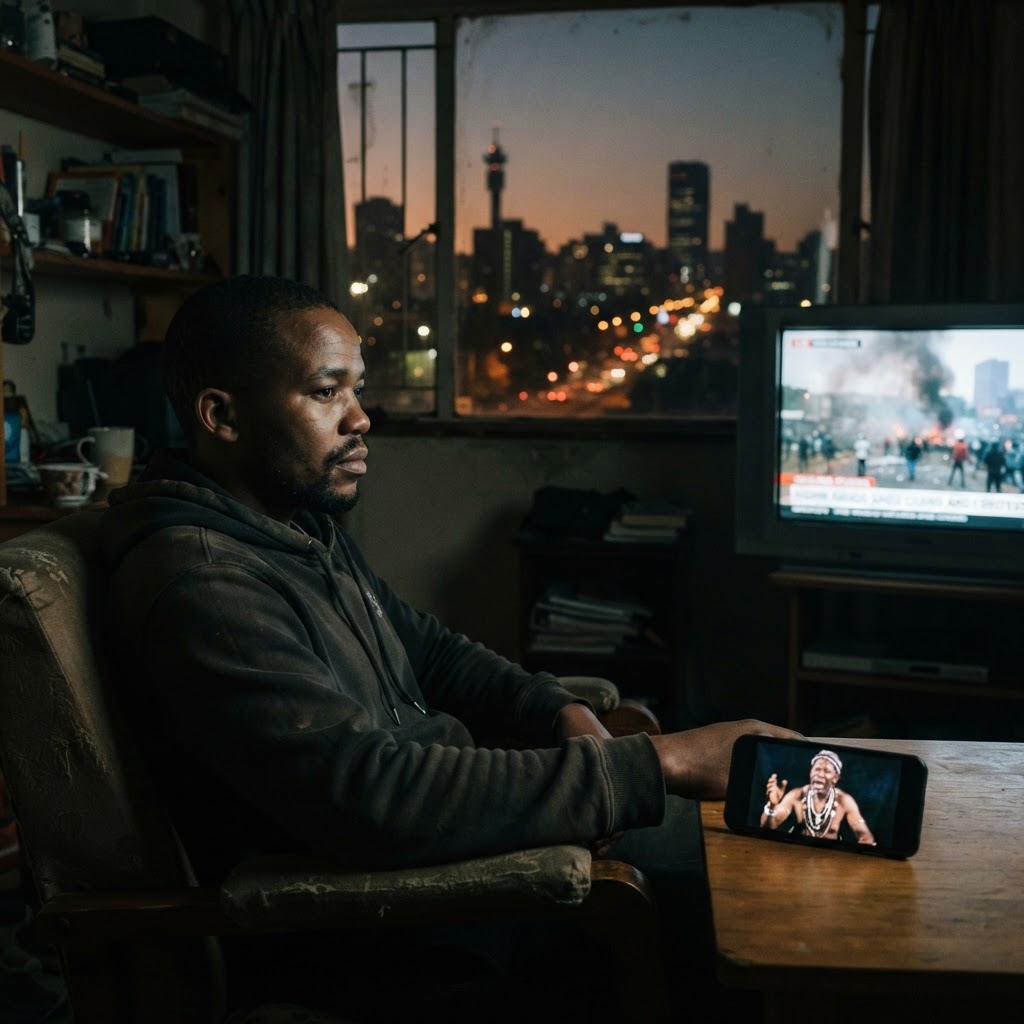
It was around eleven at night on Thursday when a cousin sent the video to the family WhatsApp group. No caption. Just a grainy clip of an old man in traditional attire, sitting in what looked like a courtyard, speaking in that slow, deliberate way that made Vusamazulu Credo Mutwa impossible to ignore when he was alive. The caption someone had typed over it said: 1993. He predicted everything. The comments underneath were a mixture of amens, fire emojis, and one aunt asking whether it was safe to drive to Durban this weekend.
By Friday morning the same clip was everywhere. Facebook. TikTok. Twitter, or X, or whatever we are calling it this year. And the question underneath all of it, the question my cousin was really asking, the question the whole country seemed to be whispering this week, was simple: is Credo Mutwa's prophecy coming to pass?

One of the protest marches this week, as shared across social media. The people carrying sticks here are the protesters themselves.
I want to write about that question honestly, because I have spent three days thinking about it, checking facts, arguing with myself, and watching parts of my country burn on my phone screen. This is a diary, not a news site, so I am not going to pretend I have the final answer. But I can tell you what I saw, what I verified, and where my mind landed.
First, Who Was Credo Mutwa?
For anyone reading this from outside South Africa: Vusamazulu Credo Mutwa was a Zulu sangoma, a traditional healer, author, painter and sculptor, born in 1921 and died in March 2020. His most famous book, Indaba, My Children, published in 1964, collected Zulu folklore, history and mythology and became one of the most widely read books ever written by a South African author. He was a genuine keeper of oral tradition in an era when apartheid was doing everything it could to crush African knowledge systems. He trained as a sangoma against the wishes of his Christian family. He lived at a kraal in Kuruman, teaching anyone who came to learn.
He was also, in his later years, a controversial figure. He spoke about aliens. He spoke about the Chitauri, a reptilian race he believed manipulated humanity. He appeared in conspiracy films that, honestly, did his reputation no favours. South Africa remembers him two ways: as a reservoir of indigenous wisdom, and as the old man in the strange videos. Both things are true, and neither cancels the other.
He also said, or is claimed to have said, many things about the future of this country. Which brings me back to the WhatsApp group.
The Prophecy Everyone Is Sharing
The clip my cousin sent is one of several doing the rounds this week. The claim attached to most of them is that Mutwa, decades ago, warned that South Africa would one day be ruled by Muslims. Some versions say Islam would take over the country. Some versions just say he saw a foreign tide changing the face of the nation. The videos are cut with footage of the news this week, and the effect is chilling if you want to be chilled.
Here is the clip that was in my family group this week. Watch it yourself and judge, because I am going to tell you honestly what I see in it.
I will be honest with you: when I watched it at eleven at night, in the dark, with the smell of load shedding candles still in the room, I felt something. I am not too proud to admit that. There is a version of every one of us that wants the chaos to have a shape, a story, a prophecy behind it. Random violence is scarier than destiny, in a strange way, because destiny at least means somebody saw it coming.
But this diary has taught me one discipline above all others: check before you feel. So I checked.
What Actually Happened This Week
Here is the factual chain of events, as reported by the news outlets I trust, and as I verified across multiple sources.
In July 2026, a Constitutional Court judgment opened a door for asylum seekers in South Africa. Following that ruling, the Department of Home Affairs issued a directive that required its refugee offices to accept and process new asylum applications. That directive set the stage for what came next.
Starting early this week, large crowds of foreign nationals, many of them reportedly from Pakistan and Bangladesh, began queuing outside the Refugee Reception Centre in Durban, run by Home Affairs. The queues were massive. The numbers being thrown around on social media went as high as ten thousand people. I could not verify that number from any mainstream source, and I looked hard, but what is verified is that the crowds were big enough to block roads and draw national attention.

Screenshots of the queues circulating on social media this week. Credit to the original uploaders.
Tensions outside that centre boiled over. Groups of South Africans gathered to protest what they saw happening. By Wednesday, 7 October, the situation was tense enough that the United States Consulate General in Durban issued a security alert to its own personnel. By Thursday, 8 October, it had escalated badly. Cars were torched. Shops believed to be foreign-owned were looted and shut. The violence was not confined to Durban: clashes broke out in Soweto, outside Johannesburg, and in Gqeberha in the Eastern Cape. The BBC reported that at least 24 vehicles were set alight. Acting National Police Commissioner Lieutenant General Puleng Dimpane promised a round-the-clock hunt for the arsonists.
And then, on Friday, the government blinked. Home Affairs withdrew the directive. Asylum applications were paused. The queues thinned. The news cycle moved on to the next thing, and the comment sections kept the prophecy videos circulating.
That is what happened. No mystery, no secret. A court ruling, a queue, a protest, a fire, a government reversal. Painful, frightening, and very human.
Now, The Hard Part: Does This Match The Prophecy?
Here is where I have to be brutally honest with myself, because it is easy to preach balance at eleven at night and harder to keep it when the whole country is shouting.
Three things did not line up for me.
First, I could not verify that Mutwa ever actually made the specific prophecy in the clip. The video says 1993. His interviews have been re-edited, re-dubbed and re-captioned so many times since his death that anyone can make the old man say almost anything. The clip embedded above is the one everybody is sharing, and I am not going to pretend it is nothing; the man in it looks and sounds like Mutwa, and the words are heavy. But I still found no primary source, no dated broadcast, no book passage. A clip with a caption is not a citation, and every one of these videos is reposted by an account selling fear or followers. That does not prove he never said it. But it does mean I refuse to build my worldview on a caption.
Second, even taking the claim at face value, the events of this week do not match it. What happened in Durban and Soweto was a fight over asylum queues and paperwork. Nothing in it was about religion. Nobody in that Home Affairs queue was asking to rule anybody; they were asking for a form to be stamped. Muslims make up roughly two percent of South Africa's population. A protest about migration documents is many things, but it is not the arrival of Muslim rule. If you have to squint that hard to see a prophecy being fulfilled, you are not reading the future. You are reading your fear.
Third, and this is the part I keep coming back to: Credo Mutwa predicted a lot of things. He warned about droughts, about strange sicknesses, about seasons unraveling, about leaders who would betray their people. Some of it tracks uncomfortably well with what we see. But a man who prophesied many storms cannot be credited for every storm. There is a difference between a prophecy coming to pass and a country being in pain, and this week South Africa was in pain.
Why We Reach For Prophets When The Country Shakes
I think the reason these videos spread so fast this week is not that people suddenly became believers in Credo Mutwa. It is that people are anxious, and anxiety goes looking for a story that explains it. Xenophobia is rising. Jobs are scarce. The queues were a visible, painful symbol of a government that many South Africans feel has stopped listening. When the world feels out of control, a prophecy gives the chaos an author. It makes the fear feel like foreshadowing instead of a random mess.
Mutwa himself deserves better than that, in my opinion. Whatever you think of his stranger claims, the man spent his life arguing that African knowledge systems were worth preserving and that South Africans would need to remember who they were to survive what was coming. He was, in his own way, an entrepreneur of knowledge, selling his life's work to a world that mostly wanted the spooky parts. Using his face to sell fear in a Facebook group is a poor tribute.
What This Means For Me, Sitting In Johannesburg
You might ask why a diary about building an online business is writing about protests and prophecies at all. Fair question. Here is my answer.
Because the country I am building in is the soil everything grows from, and this week the soil shook. When cars burn in Soweto, couriers slow down. When a city centre becomes a protest site, foot traffic dies and small traders lose a day they cannot afford. When fear rises, people spend less, click less, and scroll angrier. The unrest touched the exact world my little business lives in, even if it never came near my door. I have written before about what it costs to keep building when nothing is working. This week was a reminder that keeping the business alive is not even the whole job. Keeping perspective is.

The picture behind every headline this week: the queue outside a Home Affairs office.
So this is my resolution, written down so I can be held to it: I will not let a caption decide what I believe about my country. I will read the news, check the sources, mourn what is broken, protect what is mine, and get back to work. Prophecies do not ship products. Fear does not pay the hosting bill. Whatever Credo Mutwa saw or did not see, the only future I control is the one I build tomorrow morning, at my desk, one task at a time.
Is his prophecy coming to pass? Honestly, I do not believe this week was it. But I also think asking the question cost me something useful: it made me sit with the state of my country for three days instead of scrolling past it. Maybe that is the part of every prophecy that always comes true. Not the events. The wake-up call.
If you are reading this from Durban, or Soweto, or Gqeberha, I hope you and yours are safe. I hope the week ahead is quieter. And if a prophecy video lands in your family group this weekend, maybe ask the question I learned to ask this week: who benefits from me believing this?
That question has never once failed me.


Comments
Post a Comment